This past weekend saw the two-day Festival of South Asia take over Gerrard Street East from Glenside Avenue to Coxwell Avenue.
The main focus of the Festival of South Asia is to celebrate the diversity of South Asian culture. The festival is now in its 21st year, and is one of the largest festivals of its kind in North America. It’s a multi-cultural experience of tastes, sounds and sights of South Asia.
Throughout the day there were stage performances, a kids zone, an arts and culture market, participatory workshops and activities, and roaming entertainers along Gerrard Street. Unfortunately the sun was particularly cruel last Sunday so I didn’t stay quite as long as I would have liked.
Dance exhibitionFood stallsVendorsColourful clothes for sale in the marketMarketplacePakora, Samosas and moreSome of the Kids ZoneJewellery VendorDance exhibitionDance exhibitionMural on Gerrard Street EastHenna applicationFood truckGrilled food on Gerrard Street East
The 51st annual Festival of India (also known as Ratha-Yatra) took place this past weekend in Toronto. The very first Festival of India in Toronto launched in 1972, and has been growing steadily every year.
This year’s Festival of India parade ran down Yonge Street to Queens Quay West. Three giant floats (called Chariots) were hand-pulled by thousands of attendees and spectators, and there was much singing, chanting, drumming and dancing in the streets. Everyone was encouraged to participate. The parade attendance and spectator involvement this year was massive, due I’m sure to the public returning en masse to events post-COVID.
What is the Festival of India all about?
To answer that question, I’ll refer to a bit of explanatory text from the Festival of India’s website:
The parade down Yonge Street echoes an annual procession that has occurred for centuries in the ancient city of Puri, India. There, three mammoth chariots, known as rathas are taken on a jubilant procession, called a yatra. Hence, the Festival is also known as Ratha-Yatra or “chariot procession”. In Puri, this age-old Ratha-Yatra procession continues to attract over a million people every year!
Seated on each float (chariot) are beautifully bedecked Deities of Jagannatha (another name for Krishna or God), Baladeva (Krishna’s brother), and Subhadra (Krishna’s sister). The procession itself symbolizes the pulling of the Lord into our hearts and this is done with great pomp and grandeur.
In the late 1960s, A.C. Bhaktivedanta Swami Prabhupada, the founder of the worldwide Hare Krishna Society (ISKCON), inaugurated the North American and international versions of this ancient Indian festival. With roots steeped in spiritual traditions, the festival is now celebrated in every major city around the world, including London, Paris, Sydney, and New York.
The Toronto Festival of India Parade 2023
The chariots roll down Yonge Street surrounded by the crowdTrumpeting on a conch shellDancing down Yonge StreetPeople, people, and more people Yonge Street was very congested
If you would like to view my 2017 album of the Festival of India, which includes the post-parade activities, click here. That year the event was much less crowded and had a more subdued vibe to it.
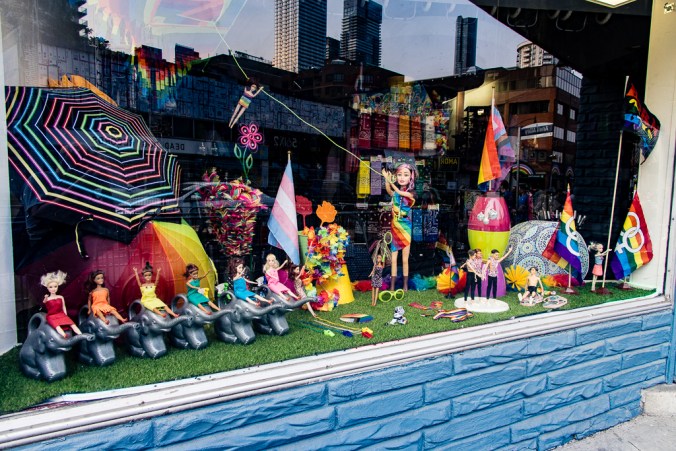
Well, the streets have been swept, the tourists have (mostly) gone and the village has settled back down to its everyday rhythm. Toronto Pride is over for another year but it left in its wake a lot of memories. For today’s TOcityscapes, I give you a small sampling of this past weekend’s mayhem (each image is clickable for a larger view).
There were…
Merchants & Vendors…
Dancing In The Street…
Pride Pups…
Lots of Love, Colour & Messages…
Random Oddities & Mayhem…
If I could put a thought bubble above this woman, it would say: “What the f…?!” I thought the same when I first saw this tree taking a cigarette break.
Coming home last night I spied this new mural on the northeast corner of Gloucester Street and Church Street. Very fitting, I thought, as we’re one week away from Pride:
I’m not exactly sure what the issue was that day, but I happened to catch this Algerian protest as I passed through Yonge-Dundas Square, April 6, 2019.
This shot always amuses me – the chic model in the upper right is completely at odds with the rest of the demonstration. The model seems to be almost mocking the crowd.
Hello to my faithful subscribers! Just a quick post today to let you know that TOcityscapes is going on a little hiatus.
I am off to Tuscany, Italy on a much-delayed photography trip. There won’t be any TOcityscapes posts for a couple of weeks, but if you’d like to follow my travel adventures on this upcoming trip, just head on over to my travel site and subscribe. That way the system will send you alerts when I publish new travel posts from Italy. I am hoping to blog daily if I can while there, but I’ll just have to see how my time goes – due to the photographic nature of this trip there will be a lot of early mornings and late nights. If I can’t blog while there I’ll definitely post once I’m home again.
Here is my travel site: Not All Those Who Wander Are Lost. You’ll find the Subscribe tool on the About and Contact pages, and in the site’s footer.
If you do subscribe – thank you! The site is “in growth” at the moment, but developing as time goes by.
The annual Good Friday Procession is a Toronto tradition which has been held every Good Friday for the last 70 years. After three dormant years due to COVID-19 the Procession, which commemorates the crucifixion of Jesus Christ, has returned to take over the streets of Toronto’s Little Italy on Good Friday.
The Good Friday Procession starts on Good Friday at 3 PM at St. Francis of Assisi Church (Mansfield Ave & Grace St), and goes through the Little Italy neighbourhood, before circling back to the church. The Procession includes religious statues, bands and people representing different characters associated with the Passion of Christ.
The Good Friday Procession follows this route:
Assembling The Procession
I’ve attended the Good Friday Procession once, in 2018, to photograph the spectacle. The most interesting shots are the ones in which the participants assemble at St. Francis of Assisi Church prior to the actual procession through Little Italy:
The Good Friday Procession Across College Street
The procession is a mile-long march re-enacting the fourteen Stations of the Cross (Jesus on his way to his crucifixion):
That’s right… across the world today – April 1, 2023 – it’s International Pillow Fight Day. What’s it all about you may ask? Today, massive public pillow fights took place in cities around the world including London, New York, Rotterdam, Seattle… and Toronto, of course!
The first World Pillow Fight day took place in March 2008, and since then the movement has grown with pillow fighting flash mobs fighting it out in more and more cities every year, all just in the name of fun. It’s simply a good way to relieve stress and have some fun; much needed these days.
The rules are fairly simple:
Swing lightly
Do not swing at people without pillows
Do not swing at people with cameras (hello!)
Soft pillows only!
Bring a bag to help with clean up after the event
International Pillow Fight Day has been on hiatus a long time in Toronto but has finally returned, post-COVID. This year I literally stumbled upon it as I passed through Nathan Phillips Square on my weekend photowalk. I grabbed some shots of the fun, and also caught a couple of gentle clouts to the head from a badly aimed rogue pillow.
I hadn’t originally planned on publishing two posts on the same day, but I learned earlier this afternoon that today is officially City of Toronto Day; it seemed worthy of notice here on TOcityscapes….
What exactly is City of Toronto Day you may ask? Well, Toronto is 189 years old today. On this date in 1834 the town of York was renamed and incorporated as the city of Toronto. Our city was designated as the capital of the province of Ontario in 1867 during Canadian Confederation.
Here’s the official proclamation of City of Toronto Day:
March 6, 2023
WHEREAS today marks the date that the city of Toronto was officially incorporated in 1834, as we reflect on 189 years of history.
For hundreds of years, Toronto has been the traditional territory of many nations including the Mississaugas of the Credit, the Anishnabeg, the Chippewa, the Haudenosaunee and the Wendat peoples. Indigenous history is ingrained in our contemporary experience of Toronto. The very name Toronto is an Indigenous word, Tkaronto, meaning “where there are trees standing in the water” and it holds importance in the Indigenous community. Our city is built on sacred land and is covered by multiple treaties, including Treaty 13 and the Williams Treaties and is home to many diverse First Nations, Inuit and Métis peoples. We are all treaty people, called to peacefully and respectfully honour the land, the Indigenous heritage and its people, which dates back to over 10,000 years.
Since its incorporation, Toronto has continued to flourish and embody its motto “Diversity Our Strength”, which can be seen in our city’s cultural and social fabric. As one of the most ethnically diverse cities in the world, our city has a global reputation for being a friendly, diverse, culturally rich city filled with vibrant neighbourhoods and unique cultures that make Toronto a great place to live and visit.
The valued contributions of Toronto’s multicultural communities strengthen our society and contribute to our city’s reputation as a global centre for business, finance, arts and culture.
NOW THEREFORE, I, Deputy Mayor Jennifer McKelvie, on behalf of Toronto City Council, do hereby proclaim March 6, 2023 as “City of Toronto Day” in the City of Toronto.
What did Toronto look like in 1834?
Here’s some interpretations from the City of Toronto Archives, Museums & Heritage Services:
On April 22, 1834, Council agreed to petition His Excellency Sir John Colborne, Lieutenant Governor, to arrange to have a plan drawn up of the new City of Toronto, its liberties, and its harbour, showing its division into wards and the relative connection of its limits with adjacent township lands.
City of Toronto, 1834
Third Parliament Buildings, 1834
The Old Gaol, Fireman’s Hall built by Mr J.G. Howard, on Church Street




I gave always loved Richmond Street. It encompasses Industrial, commercial and residential. So many lovely buildings as it winds its…