These cast bronze figures, located in the driveway of the Park Hyatt Toronto hotel at 4 Avenue Road, are entitled Mixer. The work is created by sculptor An Te Liu, a Taiwanese-Canadian artist living and working in Toronto.
Mixer envisions its installation as a stage inhabited by a pair of cast bronze figures engaged in dialogue with passersby, hotel visitors, and each other. Bold and distinctive in silhouette and richly finished in a lustrous deep gold patina, the sculptural ensemble forms a vivid and iconic tableau establishing the Park Hyatt as a singular destination.
As a public artwork, Mixer is monumental in scale – visible from afar and instantly recognizable. Open and intimate, the work invites visitors to experience the artwork fully and in the round. People become a critical part of the scenography, which unfolds within the architectural proscenium and extends out into the city.
Mixer finds shape and expression in the rich history of Park Hyatt Toronto, merging classical figurative allusions with industrial, artisanal, and organic forms culled from glassware, vessels, and couture. The forms also stem from a reinterpretation of the artistic legacy of Henry Moore, a seminal figure in the history of the modern era in Toronto.
Mixer captures the allure of social encounters and celebrates imbibing in all the senses. They form a continuity between the illustrious past of Park Hyatt Toronto and its present renaissance as an exemplar of elegance and luxury. An Te Liu’s inspiration for this work comes more specifically from an archival photograph of the Park Hyatt Rooftop Lounge, commonly known as “The Rooftop bar at Park Plaza,” years ago. An Te Liu would visit during his years as a student at the University of Toronto – understanding its social significance as a landmark in the city.
Park Hyatt Toronto invites visitors to experience the artwork in the round, as this ensemble of works seems like an encounter or conversation. The hotel program inspired this meaningful concept as a place of social convergence, where friends and strangers cross paths and mingle.
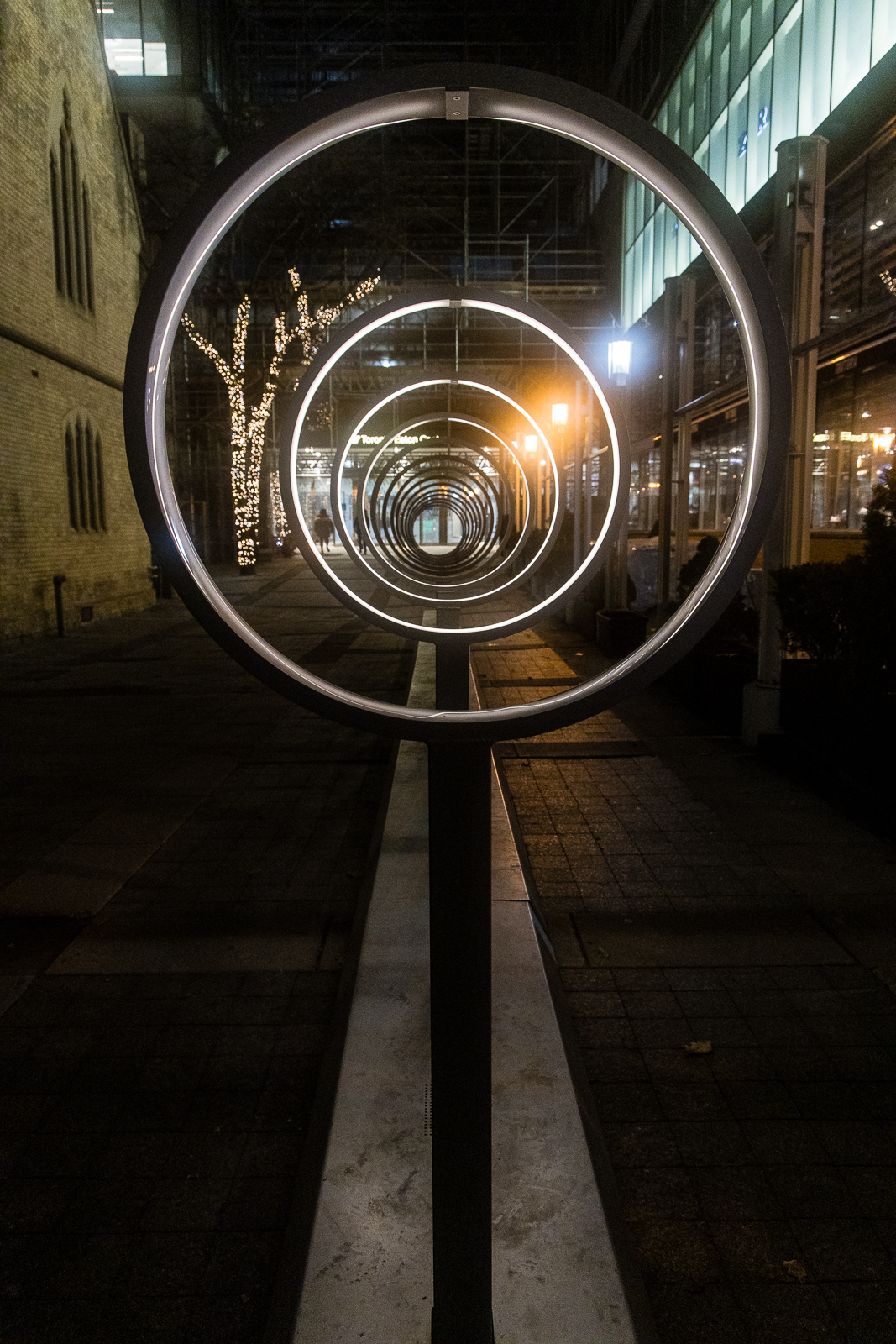
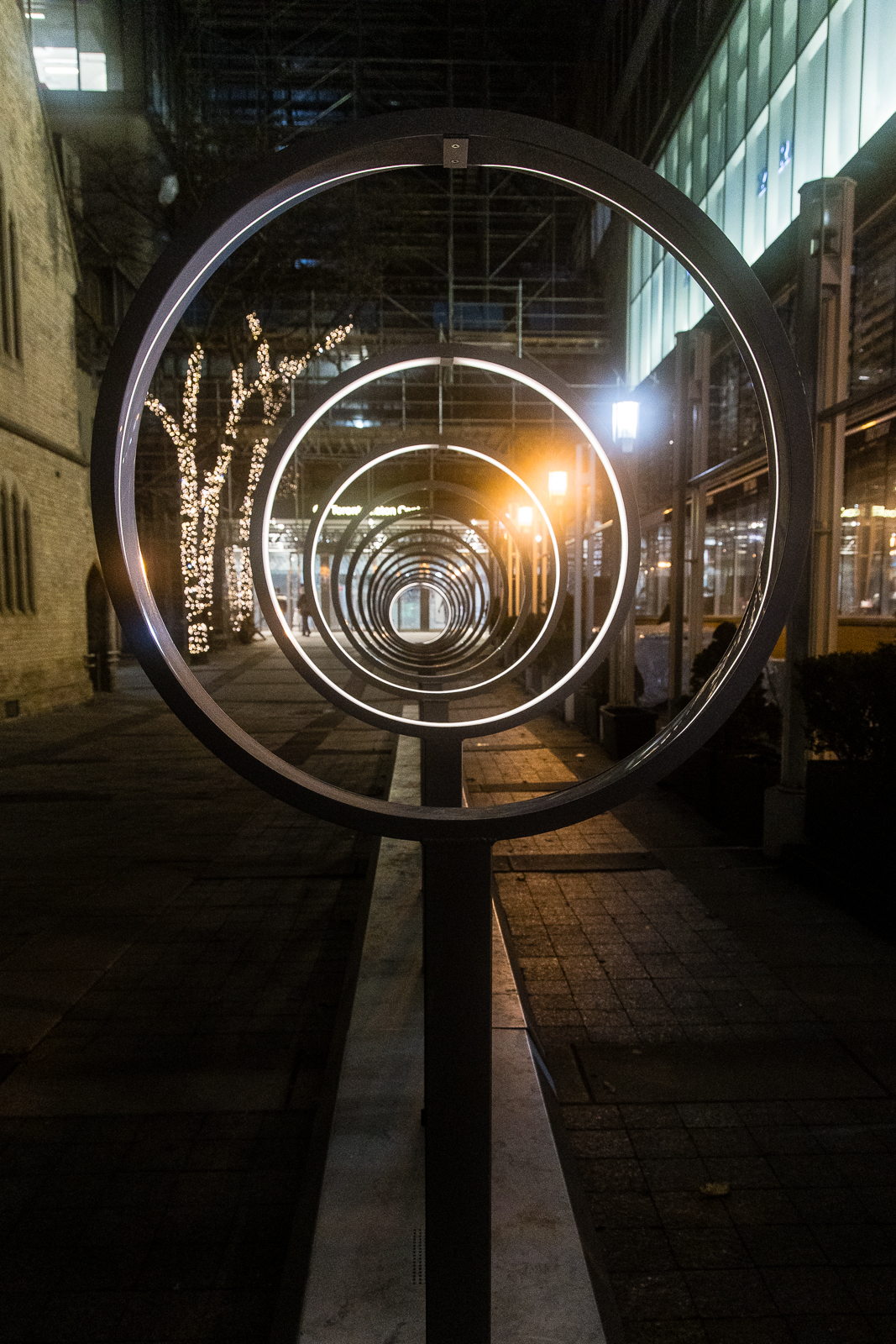
Currently running until the end of March 2024 is an interesting LED light exhibition called Illuminite. There are 6 installations in total: 2 in Yonge-Dundas Square, 3 in Trinity Square Park behind the Eaton Centre, and 1 at Yonge and Shuter Streets (although this last one I was not able to locate during my visit).
Apparently Illuminite happens every year, but this was the first year I’d personally heard of it. I believe the event has been on hiatus over COVID so that would explain its absence.
At any rate, here’s a sampling of some of the works on display (descriptions courtesy of the Illuminite website):
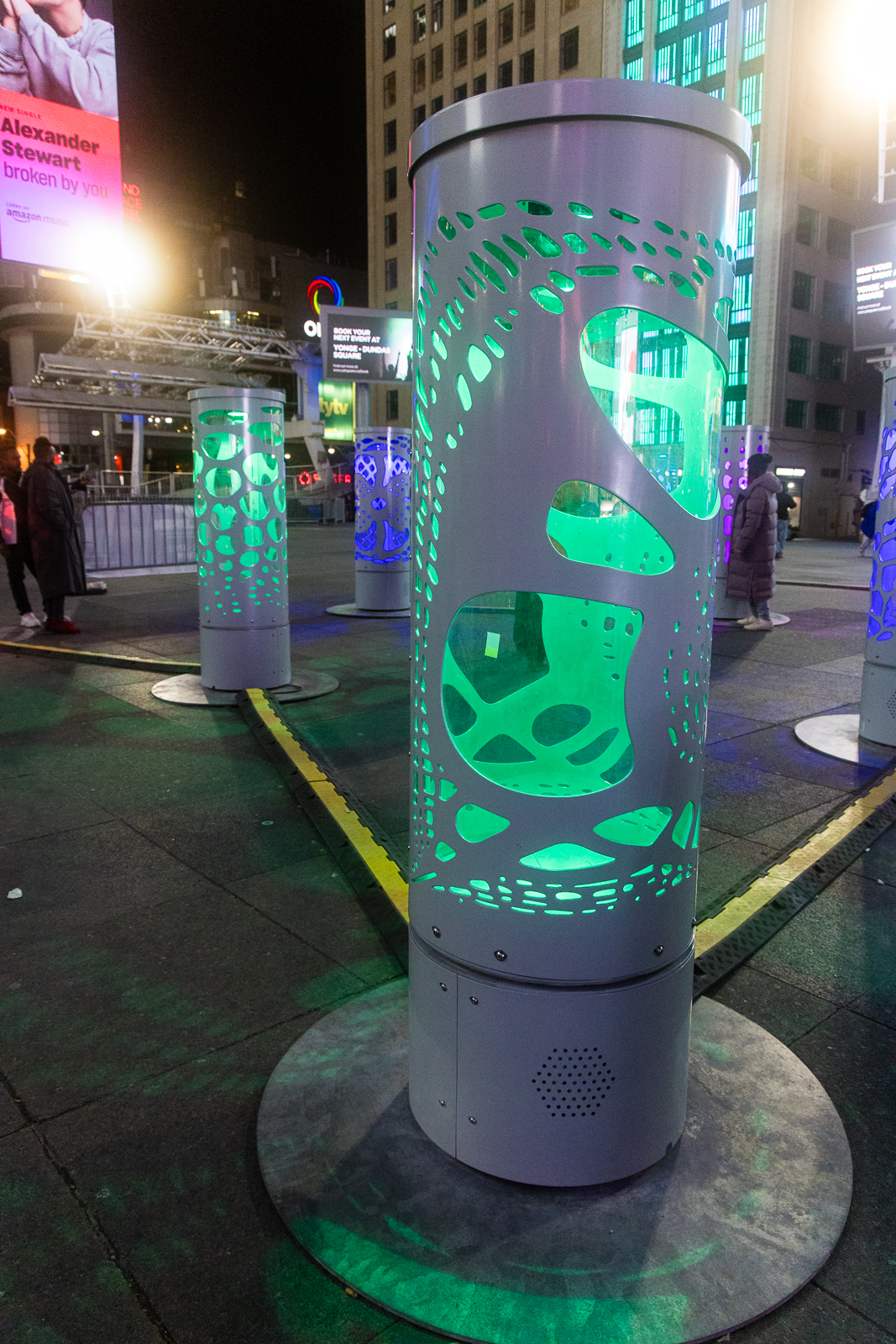
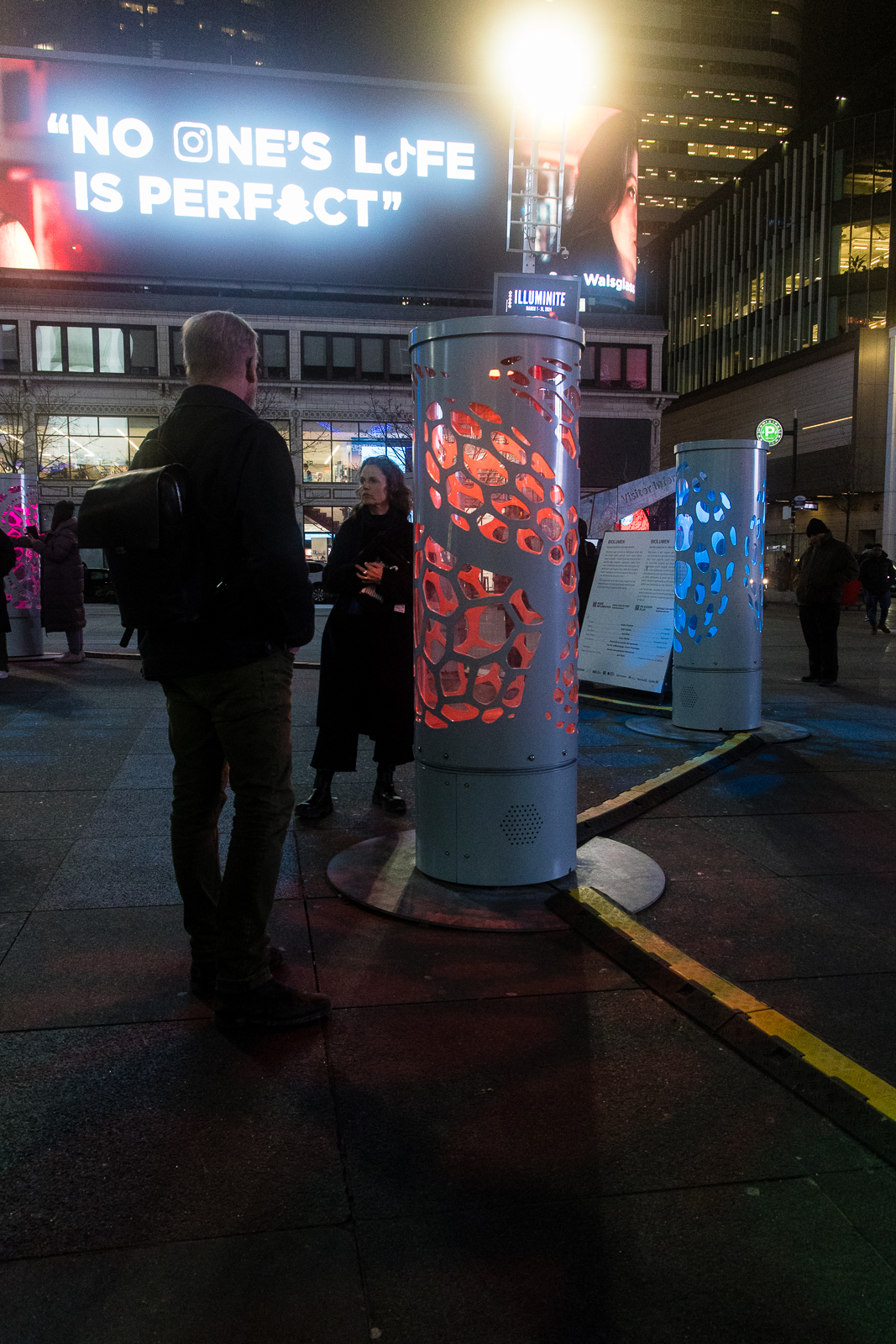
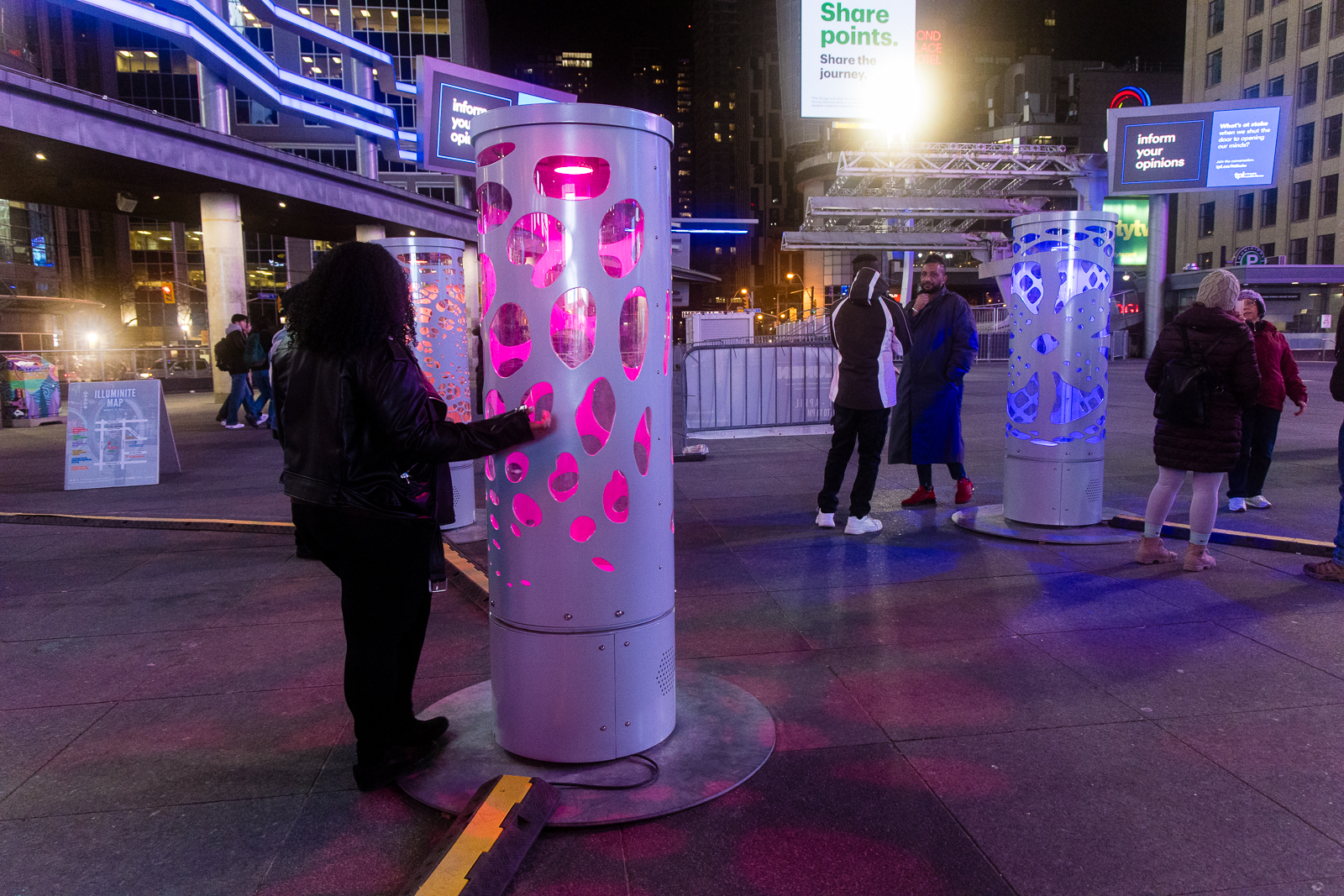
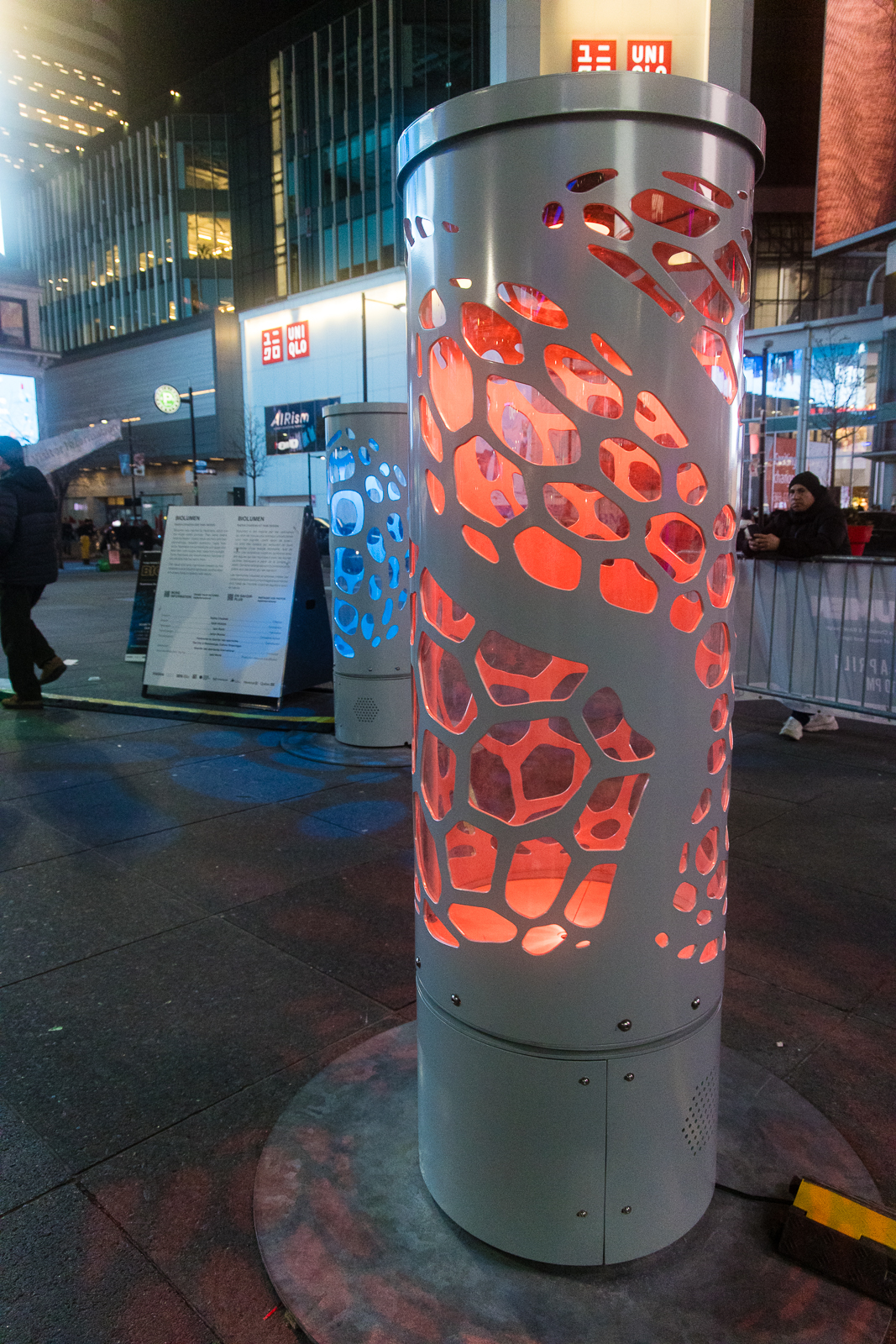
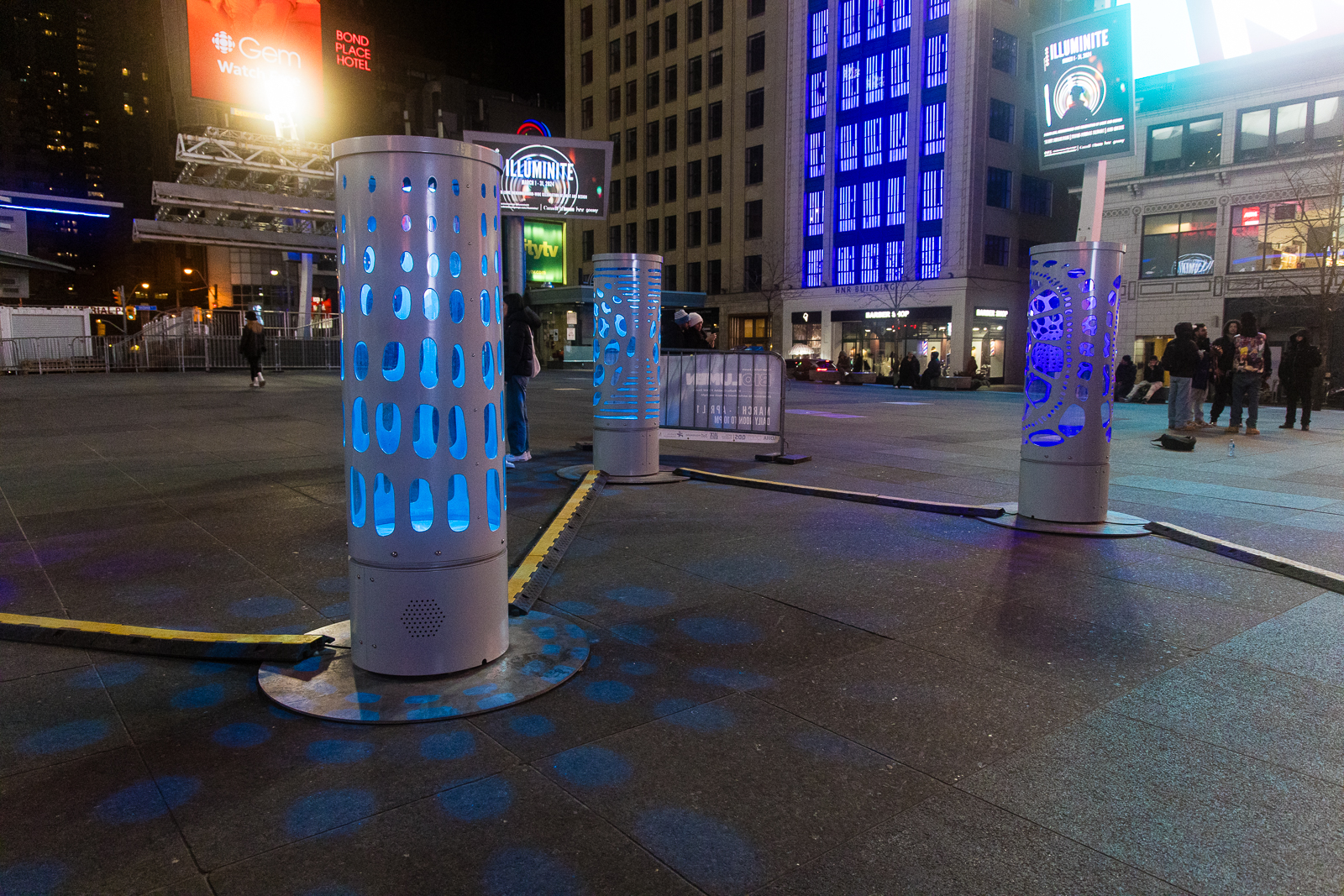
Biolumen
Artist: Radha Chaddah & RAW Design Location: Yonge-Dundas Square
Biolumen is by Toronto-based visual artist and scientist Radha Chaddah and architectural firm RAW Design.
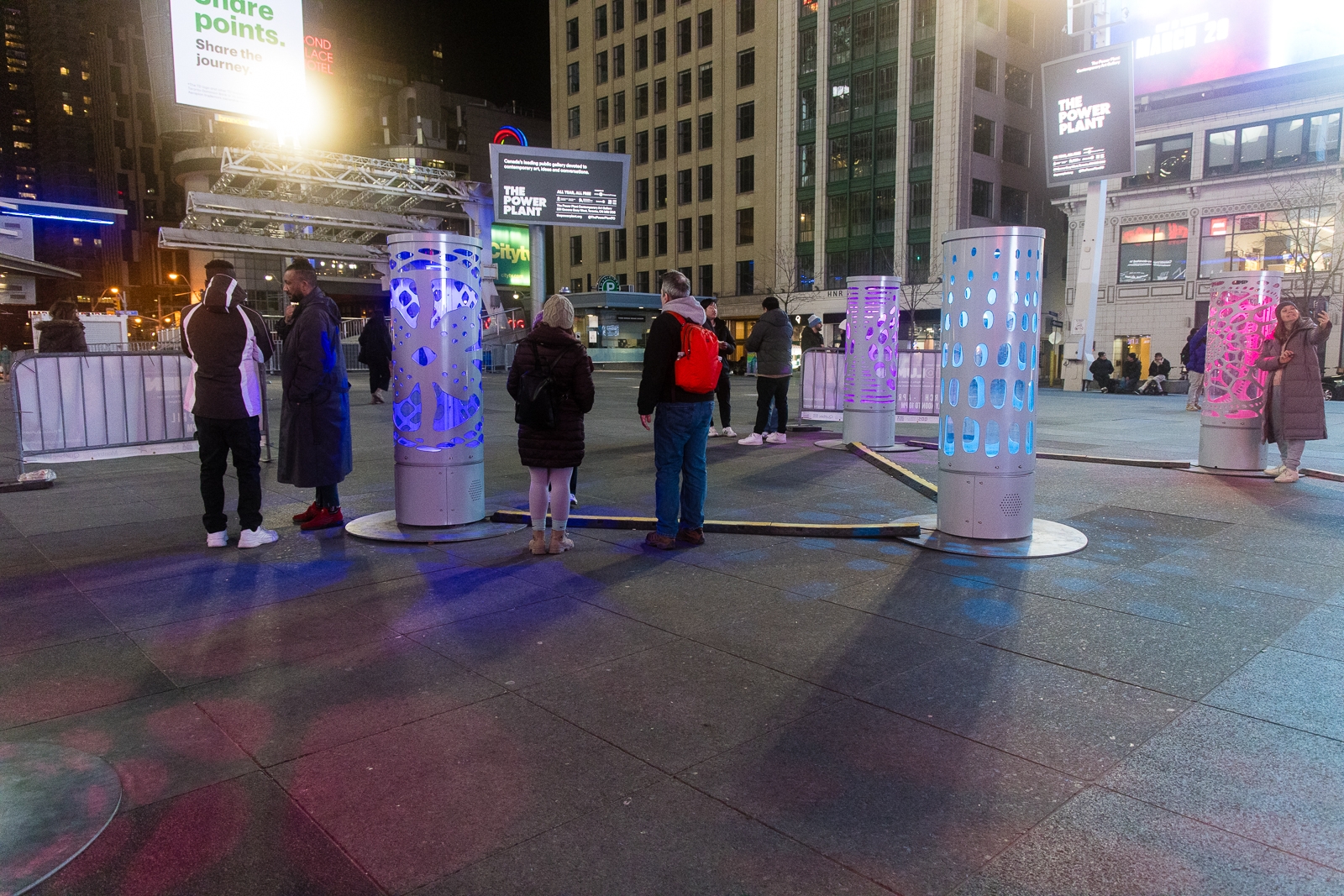
Biolumen by Radha Chaddah x RAW Design is an immersive experience with changing light,texture, and sound. The art installation features ten large luminescent structures where art, science, and nature merge. Inspired by deep-sea Radiolaria, Biolumen represents resilience and beauty in harsh environments.
During the evening hours the columns cast patterns of light when spun by participants. During the day, the columns emit ambient sounds when spun.
Click images below for slideshow:
If there were darkness enough in Yonge-Dundas Square, this is how Biolumen would appear:
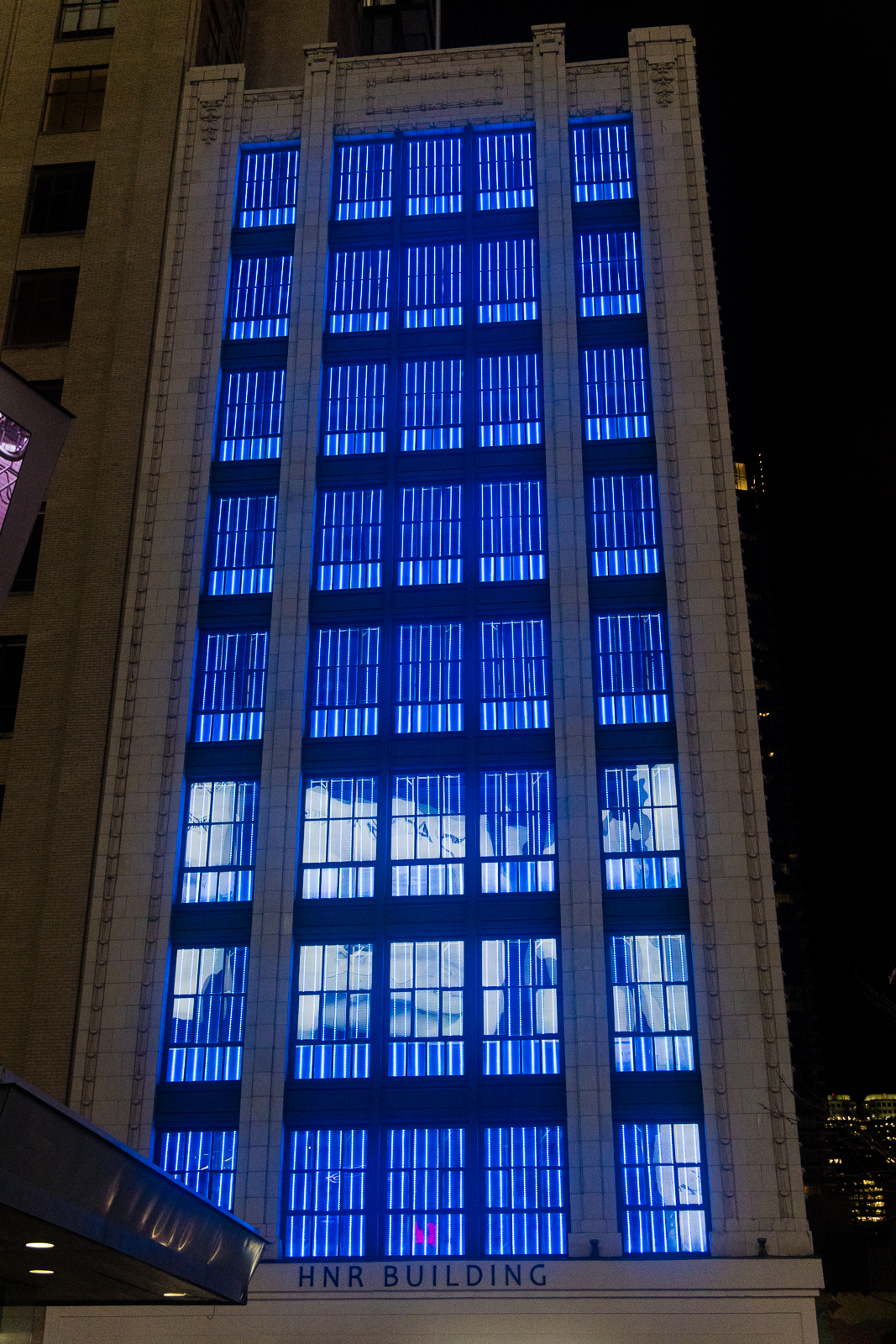
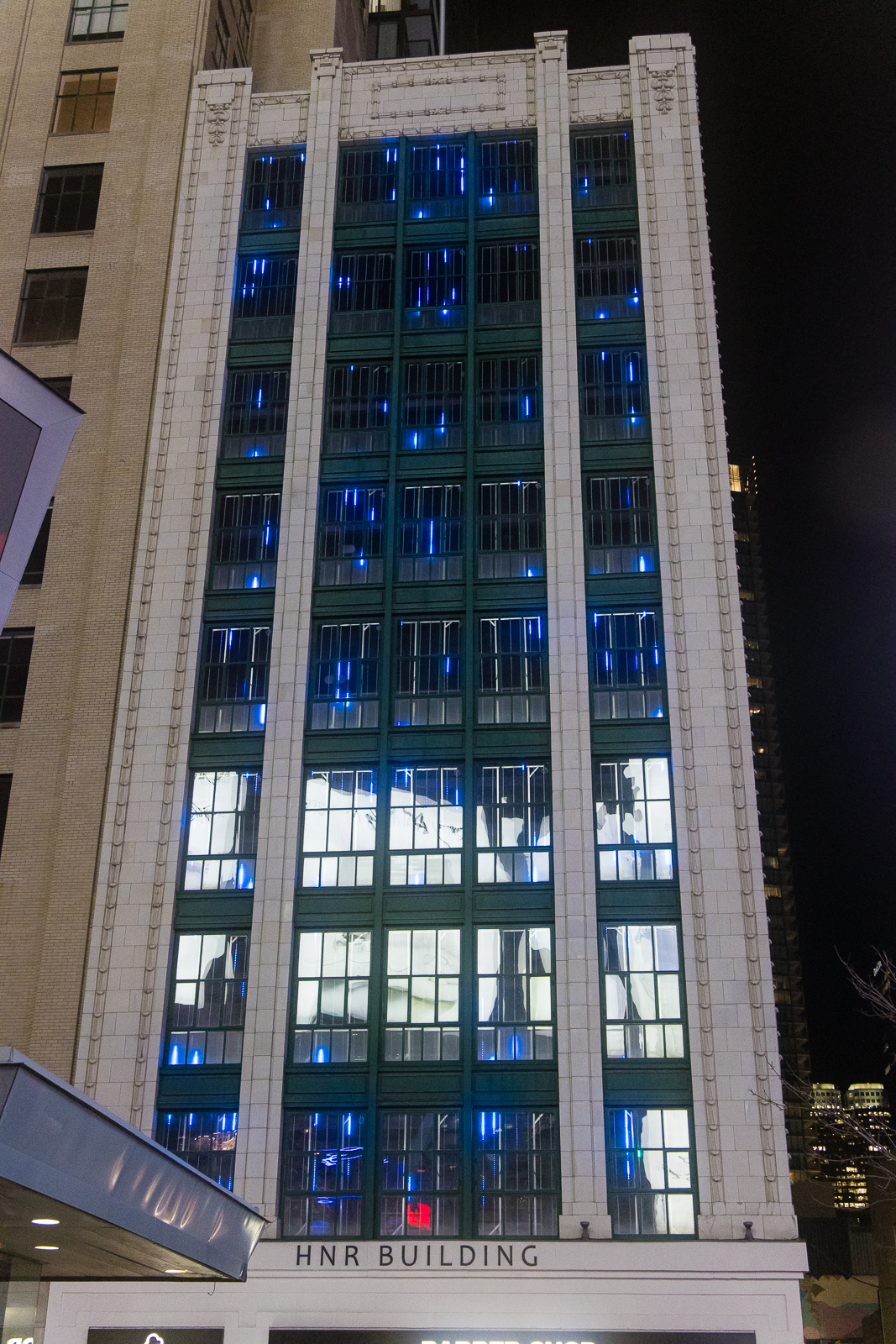
Digital Drapes is the crossover between light, motion, and architecture, where all of the windows of a building are covered in grids of programmable LEDs. Dynamic visualizations are created that work together with the unique geometry of the building to activate the entire space, turning the entire building into an interactive canvas.
Unfortunately my shots of Digital Drapes cannot do it justice; the LEDs were constantly changing and pulsating so it was hard to capture this installation at its best:
Ethera
Artist: Ariel Weiss Location: Trinity Square Park
Ethera is an interactive and LED based public art installation designed by students from the Department of Architectural Science at Toronto Metropolitan University. Toronto-based lighting design studio Urban Visuals and StrongLED also served as industry partners for the Media Architecture Biennale.
Through its polycarbonate and recycled glass-filled skin and its LED-based lighting system, the installation plays with lighting in both natural and artificial conditions.
The animated Ethera pavilion creates an immersive experience that invites visitors to disengage with the city around them, encouraging a childlike playfulness:
SAM Lamp
Artist: Sam Hardwicke-Brown Location: Trinity Square Park
This installation is a response to episodes of negative mental health that we all face throughout our lives. Through the semiotics of structure, and the use of seasonal affective disorder (SAD) light technology, the intention of the installation is to provide support to those within the structure. This noctilucent installation aims to provide temporary comfort to those in need. In the bleakest of darkness, one will find support in the light.
This project acts as a Seasonal Affective Meditation space, and temporary safe haven for those in need:
Spectrum
Artist: Spectrum by Mirari, co-production of Quays Culture and Quartier des spectacles Partnership. Distribution by QDSinternational. Location: Trinity Square Park
A listening experience, in which you are invited to engage with others in a sound-and-light dialogue. Take some time to listen, in order to see.
This interactive installation sheds light on the phenomenon of communication, by displaying the path taken by the waves generated by voices and other sounds. Here, the fundamental means of interpersonal communication, speech, is disconnected from language. Instead, it becomes a cascade of waves and luminous pulses, illustrating the fascinating trajectories of sound. Watch as your message moves from one end of the circles to the other. You will see how small gestures – invisible reverberations – can have a big impact:
The installations can be enjoyed for free daily until midnight, from March 1-31.
Illuminite has been created and sponsored by the Downtown Yonge BIA, with support from the Government of Canada and the City of Toronto.
This past weekend I visited the latest iteration of Winter Stations at Woodbine Beach. Winter Stations is a single-stage international design competition held annually in Toronto. Participants are tasked with designing temporary winter art installations which incorporate existing lifeguard towers spaced strategically across the city’s Kew and Woodbine beaches. The structures (not in use in the wintertime) are considered visual anchor points for the installations.
Every year Winter Stations has a theme; this year it was entitled Resonance.
As in previous years, Winter Stations intends to build 4-6 winning proposals for a six-week exhibition along the waterfront, funding permitted.
While Toronto beaches are not typically as well visited in the colder seasons, Winter Stations has captured the imagination of the city. Designers can expect their designs to be well-visited and should anticipate public interaction.
The Installations
This year Winter Stations is spread around a little more to offer more easily accessible locations. There are six installations on Woodbine Beach, which are the ones I’ve covered in this post. There are three more installations that I did not get to: one in Woodbine Park, one in Kew Gardens and one in Ivan Forrest Gardens.
Installation descriptions courtesy of the Winter Stations website.
Bobbin’
Bobbin’ invites the visitor to a place where pivotal moments and whimsical memories prompt reflection. It shelters visitors with slats that create an ever-changing threshold between the bobbing zone and the surrounding beach. The seesaws draw from the playground-like Sling Swing and Lifeline projects, while its form within the landscape reflects HotBox and Introspection. Each material has been sourced from previous student projects in addition to salvaged materials from the community of Cambridge. As you navigate through, bobbing up and down, a fresh perspective unfolds, encouraging resonance with the surrounding and past Winter Stations.
We Caught A UFO!
We Caught A UFO! builds upon the project In the Belly of a Bear, which utilized the lifeguard chair by lifting the public above ground into a cozy space, transporting them into a new world. We Caught a UFO! re-imagines these qualities by referencing the rumours and whispers of the many UFO sightings across Lake Ontario. However, these rumours can no longer be disputed, as there is now physical proof! Caught under a net, the UFO is wrapped in glued aluminum foil which glimmers in the light, contrasting its surroundings as a foreign object. The public (especially kids!) are encouraged to explore the UFO and can climb up into the main space where pink plexi windows transform the beach into a new tinted landscape or planet! Ultimately, We Caught a UFO! is an installation which stimulates the public’s imagination while also providing a necessary shelter from the wind and cold.
WinterAction
WinterAction is a collaborative installation between the University of Guelph Department of Landscape Architecture and Ashari Architects in Iran. Its physical form is extremely simplistic and frankly underwhelming, but that’s because this iterative installation requires a phone to get the full experience. Through an augmented reality labyrinth journey, participants are provided with the opportunity navigate from confusion to inner peace, symbolized by a virtual tree at the centre that dynamically evolves with interactions. To begin, you need to download an app from the QR code on the installation’s sign.
Nova
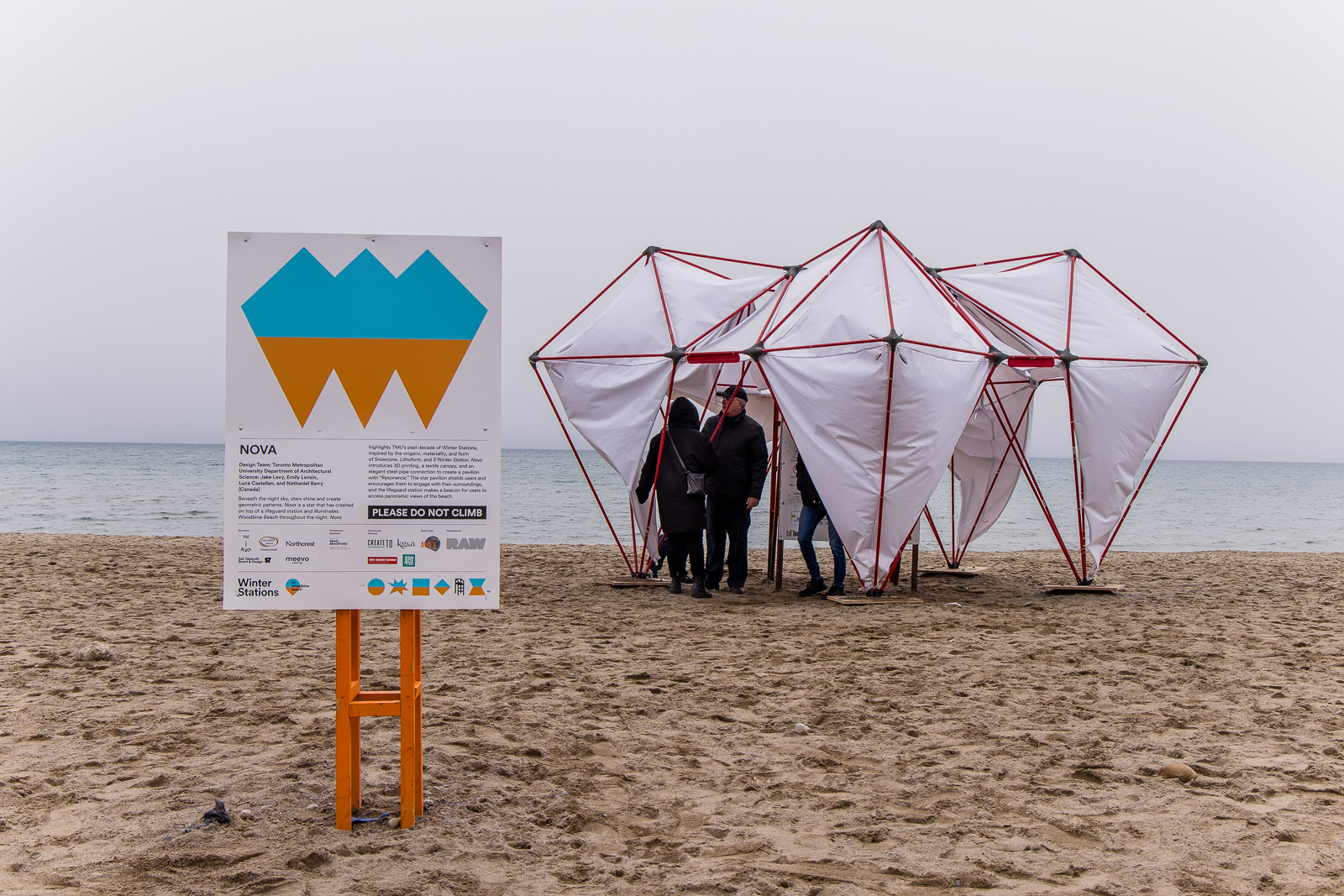
Beneath the night sky, stars shine and create geometric patterns. Nova is a star that has crashed on top of a lifeguard station and illuminates Woodbine Beach throughout the night. Nova highlights TMU’s past decade of Winter Stations, inspired by the origami, materiality, and form of Snowcone, Lithoform, and S’Winter Station. Nova introduces 3D printing, a textile canopy, and an elegant steel pipe connection to create a pavilion with Resonance. The star pavilion shields users and encourages them to engage with their surroundings, and the lifeguard station makes a beacon for users to access panoramic views of the beach.
Nimbus
Inspired by the airy strands that make up the 2016 installation Floating Ropes, Nimbus’s playful shapes and colours do more than just resonate with its predecessor. Nimbus evolves the concept and materials by adding saturated blue ropes hanging below a bubbly white structure. The station asks visitors to consider the presence and absence of rain in our contemporary world by referencing both severe storms and flooding, as well as concerning trends of lack of rain, drought, and desertification.
A Kaleidoscopic Odyssey
A Kaleidoscopic Odyssey invites onlookers to step into an experience where we challenge where reality ends and imagination begins. Explore the limitless depths of perception with this mesmerizing adaptation of Kaleidoscope of the Senses, 2020. In this installation, there are two guiding concepts. The scale of a traditional kaleidoscope is magnified 84 times to a human scale so participants can inhabit the instrument and become a part of its wonder. Where a kaleidoscope is commonly a closed-loop system, this device is deliberately severed into two sculptured equal-and-opposite parts, with purposeful space between them.
The Toronto Inukshuk resides in Toronto Inukshuk Park at 789 Lake Shore Boulevard West, west of Coronation Park.
The sculpture is one of the largest of its kind in North America, according to the City of Toronto. It stands 30 feet high and its arms span 15 feet. Made of granite, it weighs about 50 tonnes. The Inukshuk was unveiled in 2002 to commemorate World Youth Day, when Pope John Paul II visited the city.
The Inukshuk, a sculpture made up of piled stones, is a familiar symbol of the Inuit, mostly found in the Arctic landscape and often used as a navigational tool.
This Inukshuk was designed by Nunavut-born artist Kellypalik Qimirpik.
Former Mayor Mel Lastman spoke at the 2002 unveiling. His speech is engraved on this granite slab next to the Inukshuk. Part of it says:
World Youth Day has been a true navigational guide for millions of young people throughout the world. The Toronto Inukshuk invites each one of us to become beacons of light and hope, striving for justice and peace in this world.
In 2011 sculptor Ken Lum completed his work: Across Time and Space, Two Children of Toronto Meet. The piece is located west off Bay Street and south of Dundas Street West, directly behind City Hall. It involves a long passageway from Bay Street to City Hall.
Two bronze sculptures placed on either end of this corridor represent historical immigrants to the area in the form of two children from different eras. The boy wears traditional Chinese clothing, closely related to the clothing worn during the Qing dynasty including the six paneled “Little Hat,” and the tunic with a mandarin collar and frog buttons which were popular during this period.
Pinned lettering in oxidized bronze separating the children reads: Across time and space, two children of Toronto meet…
The girl wears a simple collared, long sleeve dress with a bandana tying her hair.
The work calls the audience to think about the children’s divergent histories which have preceded their settling in Toronto. Specifically, the figure of the boy in traditional clothing is symbolic of the Chinese immigrant community through his cultural clothing. In contrast, the figure of the little girl in European dress, becomes a reminder of Canada’s white immigrant history, which has interacted directly with the Chinese immigrant history in the nation.
By facing the children toward one another, Lum uses his art to point towards a complicated web of national settler histories that converge and negotiate with one another, which has taken place in this very area of the downtown core.1
While working feverishly on my new site TO Utility Boxes (which is now complete by the way), I noticed a few utility boxes that could be grouped together thematically to portray Music and Dance in Toronto.
First, though, a shameless plug for my new site: TO Utility Boxes. If you’d like to take a look, it’s here.
With that out of the way, here are some Toronto utility boxes dedicated to music and dance in our city:
Jeff Healey Tribute
Utility box painted by artist Adrian Hayles, 2018 147 Tecumseth Street just south of Queen Street West
I had looked forward to photographing this box for some time. When I finally reached the site I was extremely disappointed to see the damage done by taggers and vandals since the piece was created in 2018.
The box artist comments on his work:
Jeff Healey is a profound member of our Rock and Roll Canadian history and his knowledge of jazz is unmatched. His part in the classic movie Road House will forever mar my memory. Jeff once owned a bar called “Healey’s” at the corner of Bathurst and Queen just a couple of blocks away from his freshly painted bell box. At first, like with most public projects, I was meet with very suspicious eyes as passers-by would question my reason for being there spraying. After about two hours, the piece started to take form and the compliments came pouring in.
Queen Street Vibe in the 80s
Utility box painted by artist Glen Guerin (aka Noxious), 2018 4 Markham Street, southwest corner of Markham Street and Willis Street
Ah yes, Carole Pope and Nash the Slash. So 80s, so Queen Street West back in the day. It was all about the look – shoulder pads, raccoon eyes and bandages.
The box artist comments on his work:
The theme given me was local musicians of the “Queen St. Days”. As a patron of the Gary’s Horseshoe days, then a regular on the “Queen St. scene of the 80’s” I thought of many, many artists I’d like to commemorate in a mural who inspired me as a young artist. Then it hit me, NASH THE SLASH! However, boxes are usually two panel, and who to compliment him, but his friend Carole Pope of Rough Trade. One guy in a car stopped and yelled out who they were, gave me a thumbs up and moved on. Another middle age woman with a thick accent told me she saw Rough Trade in Poland when she was younger (who knew?!). Others were curious and asked who they were and I explained the best I could. All in all, it was a fun and learning experience and I’d do it again any day.
Echo Beach, Far Away In Time
Utility Box painted by artist Julii McMillan, 2019 5 McCaul Street, northeast corner of Renfrew Place and McCaul Street
Continuing in an 80s Queen Street vibe, this box is an excellent tribute to Martha & The Muffins.
Gordon Lightfoot
Utility box painted by artist Adrian Hayles, 2021 6 Scollard Street, in the Frank Stollery Parkette
Gordon Lightfoot… a Canadian institution.
Tribute to Salome Bey, Canada’s Queen of the Blues
Utility box painted by Adrian Hayles, 2021 2 Grosvenor Street, northwest corner of Grosvenor Street and Yonge Street
Bell Box Murals comments on this box:
If the style looks familiar, this DJ/artist/muralist has done numerous murals in the City. In 2016, Adrian took 8 weeks to paint a 22 storey Downtown Yonge BIA music mural on the north wall of 423 Yonge Street, just south of College Street. The next year, he painted the south wall of the same building, continuing the musical theme. Adrian also painted a substantial mural on Reggae Lane in the Oakwood Avenue/Eglinton Avenue West area.
The Dance
Utility box painted by artist Keight MacLean, 2017 230 College Street, northeast corner of Huron and College Streets
The box artist comments on their work:
‘The Dance’ celebrates Toronto’s communities, past and present, as a literal dance. Everyone holding hands in a continuous circle around the box, jumping and dancing barefoot and smiling and laughing. Bright fluorescent splashes of colour weave in and out of the dancing group to further highlight how people come together in Toronto to form a unique tapestry.
Dancer
Utility box painted by artist Louise Reimer, 2017 542 College Street, northwest corner of College Street and Euclid Avenue
The box artist comments on their work:
The design is an homage to dancer. In our current world, where most people work at highly sedentary jobs, it is important to promote movement and an active lifestyle. Dance is not only exercise, but expressive, non competitive, and joyful. All cultures have some form of dance, which brings people together and allows for joy and expression. Contemporary dance is the result of a lot of work done by pioneering women, and especially queer people, and people of colour, which deserves to be honoured. These groups of people are all cultural producers in Toronto who still struggle for space and recognition within the art world.
Parkdale Social Club
Utility box painted by artist Cesar Rodriguez, 2017 2 O’Hara Avenue, northeast corner of O’Hara Avenue & Queen Street West
The box artist comments on their work:
‘Parkdale Social Club’ pays tribute to the history of vibrant music and arts communities in Parkdale. It was a great experience. I met many interesting people and met some friends who happened to live and work around the neighbourhood. Some people brought me gifts and others were interested in commission some of my work as well. I was not expecting that. Even a guy who seemed homeless said he had money and would love to get some of my art.
Piano Hands
Utility box painted by Jerry Silverberg, 2013 244 Bloor Street West, northeast corner of Bedford Road & Bloor Street West
Outside The Box comments on the work:
Jerry Silverberg’s box is located across from the Royal Conservatory of Music. He chose to depict hands playing piano to acknowledge the presence of the conservatory and create synergy between the two.
Sams + A&A Records
Artist and date unknown 189 Mutual Street, northeast corner of Mutual Street & Gerrard Street East
This box is a bit of a mystery; the only ID on the box is the artist’s email address: myyummyart@gmail.com. I appreciate the throwback touch, though, to when record stores at Yonge and Dundas ruled that stretch of Yonge Street.
Dream Ballet by Hamilton native Harley Valentine sits at the southeast corner of Yonge Street and Front Street East, outside Meridian Hall (formerly the Sony Centre for the Performing Arts). Installed in 2016, the three metal abstract sculptures are 5.4-metres (18 feet) high.
The three towering figures are abstract representations of dancers and pay homage to the Meridian Hall’s former tenants, the National Ballet of Canada. The sculptor has remarked that if kids want to skateboard around the pieces, that’s fine with him; Valentine views skateboarding as a type of dance, and dance as a form of kinetic sculpting,
Sculptor Harley Valentine, with a model of his installation “Dream Ballet”
Harley Valentine has public art installations in several places in the Toronto area — including the Barbarians at the Gate exhibition at Campbell House on Queen Street West, a sculpture park in Scarborough, a permanent piece outside Humber College and a temporary installation in the Yorkville area. He’s also bidding on other projects in Palm Desert, California, New York and Detroit.
A work entitled Cross Section, comprised of large bas-relief panels made from terra cotta, covers the walls of the underground passageway between Dundas subway station and the Atrium on Bay.
Installed in 1984, Cross Section was created by Canadian artist William McElcheran, For the installation, the terra cotta pieces were oven-fired in two-foot-square tiles prior to assembly.
William McElcheran conceived the Dundas subway stop as being a cross section of Toronto. It gave him an opportunity to sculpt and celebrate the increasing diversity of Toronto’s population.
You’ll notice in the work, the presence of the rotund business man in the trilby hat. The business man seems to be rushing somewhere in each panel, occasionally bumping into people, making them spill their parcels.
Artist William McElcheran (above, right) supervises the construction of his bas-relief art piece at Dundas subway station. In McElcheran’s words, “While the sculpture shows a busy cosmopolitan scene, it is also attempting to communicate the hopes carried in people’s hearts under their overcoats, and the dreams locked in their briefcases”. Photo taken for the Toronto Archives in April 1984.
“The Businessman” seems to be a recurring character in McElcheran’s works of art. His sculpture Businessman On A Horse, found in a small square at U of T’s St. Michael’s College, exemplifies this:
My earlier post for Businessman On a Horse can be found here if you’d like to check it out.
William McElcheran is also the sculptor of Untitled, found outside the Kelly Library, St. Michael’s College (U of T), 113 St. Joseph Street:
Click here if you’d like to read my post on Untitled.
Also true to McElcheran’s style and worthy of mention is his 1981 work Conversation, found on Stephen Avenue in downtown Calgary:
William McElcheran died in 1999, leaving behind an impressive legacy. In Toronto, he created two twenty foot high marble reliefs at WaterPark Place at the foot of Bay Street, and a monumental sculpture of Daedalus and Icarus for the head office of the DuPont Corporation in Mississauga. His piece entitled The Family in Guelph has been adopted as a symbol of that city.
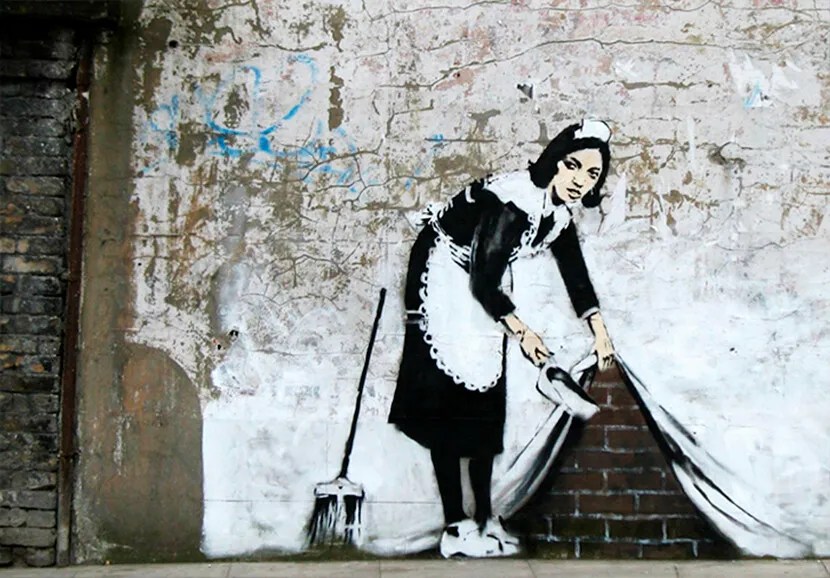
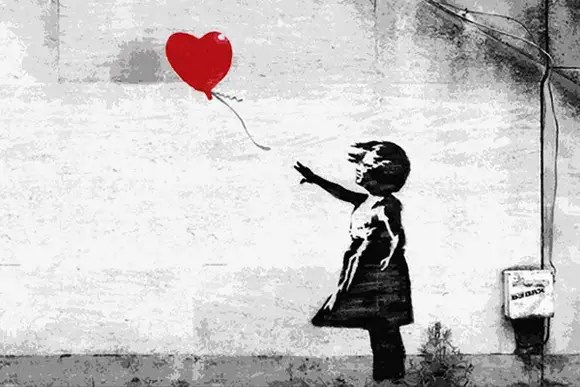
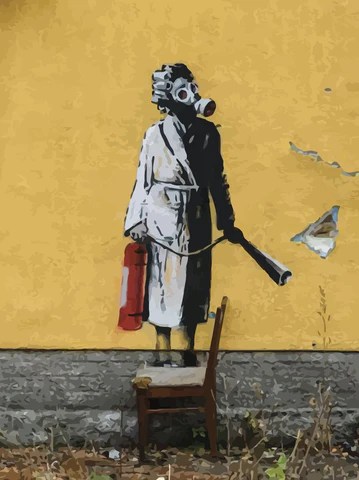
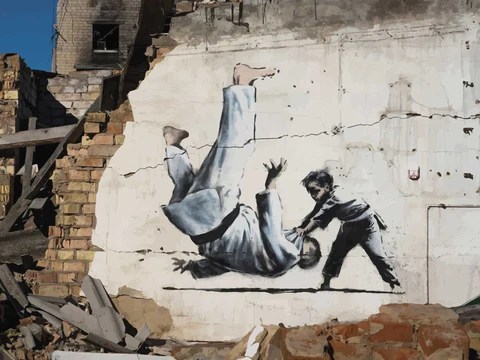
Banksy is the pseudonym of a UK-based street artist, political activist and film director, whose real name and identity remain unconfirmed and the subject of speculation. Active since the 1990s, Banky’s satirical street art and subversive epigrams combine dark humour with graffiti executed in a distinctive stencilling technique.
His works of political and social commentary have appeared on streets, walls and bridges throughout the world. Like Toronto’s own Elicser, Banksy’s art has a style which is instantly recognizable.
Here in Toronto we are fortunate to have his Guard with Balloon Dog (2010). It used to be on the exterior of what was formerly OPP headquarters in downtown Toronto. The building was torn down to make way for residential and commercial towers, but a section of the wall with the art was saved. Menkes, the company who redeveloped the site at One York Street, preserved the concrete slab and it now has a permanent home on the mezzanine level of One York Street.
There used to be 7 Banksy works scattered around Toronto, but several were destroyed or painted over. Now only two exist, including Guard With Balloon Dog.
Everything you could ever want to know about Banksy is located here.
Shooting “Guard with Balloon Dog” at One York Street
Here are some examples of Banksy’s work (disclaimer: only the first image is mine):
I came across this piece while I was visiting St. Austell in the UK. The work resides on a door beside the Cafe Tengo. If it’s not a genuine Banksy, it’s a great imitation.
Several of you will instantly recognize this very familiar site! Today we take a look at the Griffins (or Gryphons) guarding the main entrance of the Lillian H. Smith branch of the Toronto Public Library at 239 College Street.
The figures were designed and constructed by architect Philip H. Carter and sculptor Ludzer Vandermolen. The griffins took their permanent place beside the entrance when the branch opened in 1995.
Edgar and Judith
Each griffin weighs 3 tonnes or 3000 kilograms and took about 1.5 years to make. Small clay models were approved by the Library Board, then enlarged and cast in fibreglass and wax before being sent to the foundry. Since they are so big, they were cast in different sections – about 12 parts for each statue. The bronze finisher was Vince Graham.1
The griffins have their own identity and heritage: the lion is Edgar (east side of door) and the eagle is named Judith. If you study the griffins for a while you will soon see various little animals embedded into each main figure.
Judith
Judith resides on the west side of the library’s main door. It is named for the Merril Collection of Science Fiction, Speculation and Fantasy.
Edgar
Edgar guards the east side of the library’s main door. He is named after the benefactor of the Osborne Collection of Early Children’s Books.
Near the griffins, but not part of them, is this owl. Prior to taking up residence at Lillian H. Smith branch it was situated at the entrance of the old Boys and Girls House library on St. George Street.
If you’d like to read about the history of Lillian H. Smith and the Toronto Public Library in general, here are a couple of interesting articles:













The word hidden is often overused but in this case it feels apt. This large space is quite pretty and…