TO Cityscapes

Toronto Through My Lens

Page 8 of 35

Beaty Boulevard Parkette

Beaty Boulevard Parkette is a long, finger-like patch of grassy, manicured land situated near the intersection of Queen Street West, King Street West and Roncesvalles Avenue:

There’s plenty to see and do in this historic neighbourhood; if one crosses the Pedestrian Bridge over busy Lakeshore Boulevard West, you will find the Palais Royale, the Boulevard Club, Budapest Park, Marilyn Bell Park and Sunnyside Beach.

A Bit Of History

Beaty Boulevard Parkette is the former location of the Sunnyside Railway Station, located at this King/Queen/Roncesvalles intersection. The Sunnyside Railway Station operated passenger service from 1910 until 1971.

The Sunnyside Station in 1915 (City of Toronto Archives)

The station was built by the Grand Trunk Railway in 1910 and was well-placed, with access to nearby streetcars and the Sunnyside Amusement Park.

GO Transit began service in May 1967 and took over CN’s Toronto to Hamilton route. While CN’s Hamilton train had stopped at Sunnyside, GO’s Lakeshore West line bypassed the station resulting in a significant drop in its use. CN closed the station in 1971 and its buildings were demolished in 1973.

The Katyń Monument

Beaty Boulevard Parkette is home to the Katyń Monument, which commemorates the 1940 Katyń massacre in Poland:

“In remembrance of fifteen thousand Polish prisoners of war who vanished in 1940 from the camps in USSR at Kozelsk, Ostashkov, Starobelsk. Of these over four thousand were later discovered in mass graves at Katyn, near Smolensk, murdered by the Soviet state security police.”

Made of bronze and erected in 1980, the monument was created by artist Tadeusz Janowski. The monument’s location here is quite appropriate in this, a largely Eastern European, neighbourhood.

“In remembrance of fifteen thousand Polish prisoners of war who vanished in 1940 from the camps in USSR at Kozelsk, Ostashkov, Starobelsk. Of these over four thousand were later discovered in mass graves at Katyn, near Smolensk, murdered by the Soviet state security police.”

But what was the Katyn massacre you may ask? The Katyn Massacre was a series of mass executions of nearly 22,000 Polish military officers and intelligentsia prisoners of war carried out by the Soviet Union, specifically the NKVD (“People’s Commissariat for Internal Affairs”, the Soviet secret police) in April and May 1940. Though the killings also occurred in the Kalinin and Kharkiv prisons and elsewhere, the massacre is named after the Katyn forest, where some of the mass graves were first discovered by German Nazi forces (Source: Wikipedia).

The Smolensk Tragedy

Also in Beaty Boulevard Parkette is a secondary monument related to the Katyn Massacre. The inscription on the plaque for this memorial reads:

In memory of the 96 person Polish delegation headed by the President of the Republic of Poland Lech Kaczynski, who all died tragically in a plane crash at Smolensk, on April 10, 2010, en route to the official commemoration ceremony of the 70th anniversary of the Katyn Massacre. Without the Katyn Massacre there would have been no Smolensk tragedy.

Canadian Polish Congress, April 10, 2011

Memorial For Perished Polish Soldiers & Civilians

A few feet away from the last two monuments there is a third: this is the Memorial For Perished Polish Soldiers & Civilians:

The plaque on the memorial reads:

1940-2000

In Memoriam… Lest We Forget

May the tragic death of tens of thousands of Polish citizens in Soviet forced labour camps, political prisons and execution sites, always remind the world that freedom is bought with great sacrifice.

Dedicated to the memory of over one million seven hundred thousand Polish soldiers and civilians arrested in eastern Poland by the Soviet Secret Police (NKVD) in 1940-1941, for the only reason that they were Polish citizens and were departed to the far reaches of the Soviet Union (Siberia), where many were executed or died of hunger, cold, disease and exhaustion during World War II.

Alliance of the Polish eastern provinces in Toronto, February 10, 2000

Stay tuned for the second part of this post – a look at Budapest Park, which is on the other side of Lakeshore Boulevard West beside Lake Ontario.

“Mixer”

These cast bronze figures, located in the driveway of the Park Hyatt Toronto hotel at 4 Avenue Road, are entitled Mixer. The work is created by sculptor An Te Liu, a Taiwanese-Canadian artist living and working in Toronto.

Mixer envisions its installation as a stage inhabited by a pair of cast bronze figures engaged in dialogue with passersby, hotel visitors, and each other. Bold and distinctive in silhouette and richly finished in a lustrous deep gold patina, the sculptural ensemble forms a vivid and iconic tableau establishing the Park Hyatt as a singular destination.

As a public artwork, Mixer is monumental in scale – visible from afar and instantly recognizable. Open and intimate, the work invites visitors to experience the artwork fully and in the round. People become a critical part of the scenography, which unfolds within the architectural proscenium and extends out into the city.

Mixer finds shape and expression in the rich history of Park Hyatt Toronto, merging classical figurative allusions with industrial, artisanal, and organic forms culled from glassware, vessels, and couture. The forms also stem from a reinterpretation of the artistic legacy of Henry Moore, a seminal figure in the history of the modern era in Toronto.

Mixer captures the allure of social encounters and celebrates imbibing in all the senses. They form a continuity between the illustrious past of Park Hyatt Toronto and its present renaissance as an exemplar of elegance and luxury. An Te Liu’s inspiration for this work comes more specifically from an archival photograph of the Park Hyatt Rooftop Lounge, commonly known as “The Rooftop bar at Park Plaza,” years ago. An Te Liu would visit during his years as a student at the University of Toronto – understanding its social significance as a landmark in the city.

Park Hyatt Toronto invites visitors to experience the artwork in the round, as this ensemble of works seems like an encounter or conversation. The hotel program inspired this meaningful concept as a place of social convergence, where friends and strangers cross paths and mingle.

Text source: Park Hyatt Toronto website

Night Walk On Yonge Street

Photo Project

Using a filter and utilizing some moody street lighting, my intent was to emulate – if possible – those wonderful, grainy old 1940s/50s night images of a large urban centre in the wee hours.

I captured these images a few weeks ago when walking in the Yonge-Dundas area:

Wellesley Street East During Solar Eclipse

When the solar eclipse passed over Toronto this past Monday (April 8, 2024) I dashed out of my workplace on Wellesley Street East with camera in hand and shot a few images as the darkness progressed.

Although we were not in the path of totality, it became quite dark. There was some very heavy cloud cover that day, so unfortunately we weren’t afforded a direct view of the eclipse, but it was still a very unique experience. Here’s how things looked in my corner of the world that day:

2:10 PM

2:13 PM

2:17 PM

2:18 PM

2:19 PM

2:20 PM

And then it quickly passed and became light again. The eeriness of it was great while it lasted…

Jean Lumb Lane

In Chinatown there exists a small lane dedicated to the memory of a remarkable Chinese-Canadian woman named Jean Lumb:

Jean Lumb Lane, off Dundas Street West, near Huron Street

Who Was Jean Lumb?

Since coming to live in Toronto I have heard the name Jean Lumb mentioned but was not aware of her historical importance and influence until doing a bit of research.

Jean Lumb was the first Chinese-Canadian woman, and the first restauranteur, to receive the Order of Canada for her community work. Most notably, she was recognized for her pivotal role in changing Canada’s immigration laws that separated Chinese families, and for her contribution in saving Toronto’s First Chinatown.

Jean Lumb was very active in community work throughout her life. As mentioned earlier, she was instrumental in organizing the campaign to save Toronto’s First Chinatown from complete demolition. She also galvanized the community against further expropriation of remaining portions on Dundas Street West.

Jean was a major force – and the sole woman – in the 1957 Chinese delegation which lobbied the government of John Diefenbaker. They lobbied to repeal explicit racial discrimination from the immigration laws, which contained race-based criteria for admission to Canada.

Early History

Jean Lumb was born in Nanaimo, B.C. in 1919. Her father emigrated to Canada to work as a farm labourer. Jean Lumb left school at age 12 to work and support her family. In 1935, she moved to Toronto and later opened her own grocery store here at the age of 17.

The mother of six children and grandmother of nine grandchildren, Jean Lumb was the co-owner (with husband Doyle Lumb) and director of the Kwong Chow Restaurant in Toronto for 23 years. The restaurant was highly successful and popular with both Chinese and Westerners, with many clientele who were politicians due to its proximity to Toronto’s City Hall.

Jean achieved many “firsts” in Toronto. This included being the:

  • First Chinese woman on the board of governors of the Women’s College Hospital.
  • First Chinese woman on the board of University Settlement House
  • First Chinese restaurateur and first woman to receive the Fran Deck Award for outstanding achievement in Toronto’s restaurant industry
  • First Chinese-Canadian woman to sit on the board of Rotary-Laughlen Centre

She also served as director and honorary advisor of the Yee Hong Chinese Nursing Home for Greater Toronto and the Chinese Cultural Centre of Greater Toronto, respectively.

Jean Lumb was honoured with around 20 Awards, her first being the Order of Canada in 1976.

This remarkable woman’s legacy continues long after her passing in 2002. The Jean Lumb Foundation awards high school students with Chinese heritage annually for their accomplishments.

You can visit the Jean Lumb plaque in Diversity Garden (southeast corner of Elizabeth Street and Foster Place) near the original site of the Kwong Chow restaurant.

The Jean Lumb Lane was officially opened on November 13, 2019 (below):

Photo: Chinatown BIA

If you’d like to listen to Jean Lumb’s daughter Arlene Chan and Jean Lumb herself, here is an interesting YouTube video:

Stackt Market

Stackt Market is a truly unique concept. Located at 28 Bathurst Street at Front Street West, Stackt Market has been awarded “Public Space of the Year” by Designlines Magazine, and is also the winner of “Retail Innovation for Fast Company’s Innovation by Design”.

Opened in the summer of 2019, Stackt Market is built entirely from 120 reclaimed shipping containers which create 100,000 square feet of art, retail, events and public space. The containers are – wait for it – stacked, with those on the bottom retrofitted and occupied by pop-ups, creative incubators, 30+ retailers and food/beverage vendors. The shipping containers up top act as large canvasses for local and international artists, drawing attention to the site from the many surrounding condo developments and office towers. Stackt Market is also home to 300+ annual events and 7 annual festivals which put community at the forefront.

Designed by LGA Architectural Partners’ Janna Levitt and Danny Bartman with Stackt Market founder Matt Rubinoff, Stackt Market inhabits the site of a former smelting plant. The 2.4-acre-lot is roughly the size of two city blocks.

Onsite Art Gallery

Even the WC were container-like…

Stackt Market is strong on community and art. According to their website:

STACKT is on a mission to innovate a new experience where customers, businesses, art and hospitality thrive as one. STACKT is built on the idea that commerce is culture, and culture is community made. The community is made up of innovators, creators, collaborators, and consumers alike.

Come check it out!

Toronto Comicon 2024

Toronto Comicon is an annual comic book and pop culture convention held in Toronto at the Metro Toronto Convention Centre since 2001.

When it comes to the worlds of Fantasy, Sci-fi, Cosplay, Roleplay, LARPing, etc., I’m quite out of the loop and couldn’t identify with much of what I saw that day, but it was all quite fascinating nonetheless. I’ve come to the conclusion that people just simply love to dress up no matter the occasion, and this convention gives them a very generous outlet to do just that.

To attend a Comicon to shoot the costumes has been on my photo radar for a number of years, and it was fun to finally do that this past weekend. The sheer mass of people was almost overwhelming and all 3 floors of the Metro Convention Centre, plus the North Building, were jammed with attendees.

This event had it all, including:

Wardrobe malfunctions…

Miles of comic books…

Masses of people…

Epic battles…

Boardgames…

Memorabilia for sale (lots!)…

And – of course – some great costumes…

St. Patrick’s Day Parade

In a nutshell, St. Patrick’s Day observes the death of St. Patrick, the patron saint of Ireland. The holiday has evolved into a celebration of Irish culture with parades, special foods, music, dancing, drinking (and more drinking, and more drinking) and the wearing of a whole lot of green.

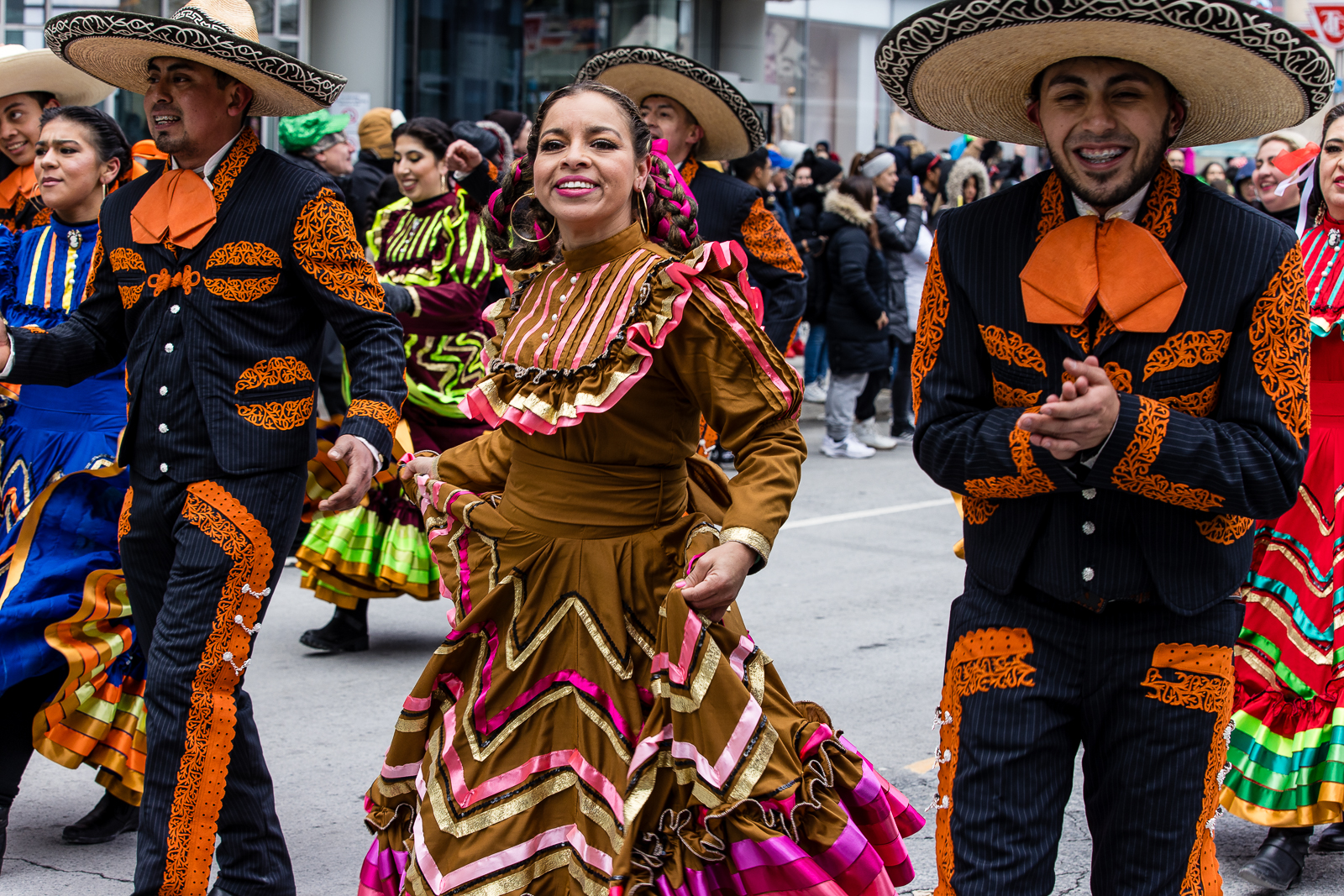
Here’s a few shots of the parade that went down Yonge Street. In true Toronto style it proved to be a fully multi-cultural event:

A Walk Down Roncesvalles Avenue

I love Roncesvalles (aka Little Poland) – it has such a welcoming village-feel to it and exudes a laid-back yet slightly hip vibe. Roncesvalles Avenue itself stretches for 1.8 km, and is filled with gardens and charming, independent shops along the way. About 15,000 people live in Roncesvalles Village’s vintage buildings.

Known as “Roncy” to the locals, Roncesvalles consists of the stretch of Roncesvalles Avenue from Bloor Street south to Queen Street West.

“They Came From Roncesvalles”
The mural wall which greets visitors. The artists who painted this mural are Spud1, Wales, Random & Cruz.
More of the Mural
Artists: Spud1, Wales, Random & Cruz

A Very Brief History of Roncesvalles

Roncesvalles Avenue was originally owned by Colonel Walter O’Hara who named the street after the Roncesvalles gorge in Spain, where he had won a battle against Napolean’s army circa 1813. British settlers began to arrive in the early 1900’s as residential homes appeared. After WWII large numbers of Polish immigrants arrived and set up all sorts of businesses; that is why this neighbourhood celebrates the Roncesvalles Village Polish Festival every year.

Little Poland

Culturally, the area is known as the centre of the Polish community in Toronto with prominent Polish institutions, businesses and St. Casimir’s Catholic Church located on Roncesvalles Avenue. The businesses along Roncesvalles have formed the Roncesvalles Village Business Improvement Area and hold the largest Polish Festival in North America, which takes place every September.

Mural Outside “Jimmy’s Coffee”
2210 Dundas Street West. You know the area is urban-hip when there’s a Jimmy’s Coffee in the ‘hood.
The Revue Cinema, 400 Roncesvalles Avenue
Built between late-1911 and early-1912, the theatre is a designated heritage site and is Toronto’s oldest standing movie theatre in use for showing movies. When news of its closure became public, a grass-roots community movement sprang up in order to save the cinema. After a great deal of effort, the movement was ultimately successful and the Revue reopened in October 2007. It is now operated by the not-for-profit “Revue Film Society”.

Roncesvalles is very well known for the large number of small restaurants, cafés and specialty food shops of various cuisines. There are several bakeries and delicatessens found along the full length of Roncesvalles.

Patios along Roncesvalles Avenue
One of the many fruit and veg shops along Roncesvalles Avenue
Sweetpea’s Floral & Gift Boutique
This is a floral studio located at 294 Roncesvalles Avenue. It’s widely recognized as Toronto’s Best Florist (Toronto Life, BlogTO).
Another shot of Sweetpea’s
Sweetpea’s was just so colourful and inspiring I had to take yet another shot…
Neighbourhood garage doors, Roncesvalles Avenue
St. Vincent de Paul Catholic Church
263 Roncesvalles Avenue
St. Vincent de Paul Catholic Church
Pope John Paul II Monument
The piece was created in 1984 by Alexander von Svoboda. The bronze statue sits outside St. Casimir’s Polish Parishes Credit Union Limited at 220 Roncesvalles Avenue.
The Chopin Restaurant
Polish cuisine, 165 Roncesvalles Avenue
More fruit & veg shops
Old-style barber’s pole on Roncesvalles
In window of Roncesvalles restaurant. Plenty of restaurants in Roncesvalles.
Grafton Community Garden
In Grafton Avenue Park, 23 Roncesvalles Avenue. Resident Walter Ruston painted the mural (on wall behind the garden) of the Sunnyside Amusement Park. This area used to be a neglected scrap of land but was turned into a thing of beauty by local gardening committees.

I’ll leave you with a couple of sites to explore it you’d like to learn more about Roncesvalles:

From Destination Toronto:
An excellent post on their website

Roncesvalles BIA:
Local info found here

« Older posts Newer posts »

© 2026 TO Cityscapes

Theme by Anders NorenUp ↑

Pin It on Pinterest