Toronto Through My Lens

Category: Architecture (Page 4 of 8)

Jarvis Street Heritage

I’ve been working on this post for months, off and on. Originally I had entitled it Jarvis Street Mansions and thought I’d focus exclusively on the remaining mansions from Jarvis Street’s so-called golden era. As I walked up and down Jarvis Street capturing shots for this post, I encountered a fair number of buildings that, while not necessarily “mansions”, are heritage buildings with historical significance. Doing a little research I could find the history/background on many of these Jarvis Street structures; conversely some seem to have left no legacy at all.

There have been hundreds of articles written on how Jarvis Street looked about 120 years ago or more – it must have been exquisite. These days if you stand outside one of the surviving mansions and mentally dismiss the solar panels, traffic lights, garbage cans, bike stands, crosswalks, electric skateboards, honking horns and other trappings of the 21st century, you can imagine how it must have looked in a different era.

View of Jarvis Street, 1915

A Walk Up Jarvis Street

The Corner of Jarvis Street and King Street East

Except for the St. Lawrence Market there’s not many – if any – historical buildings on Jarvis Street south of King Street East, so this little tour of Jarvis Street will begin at this corner and work north to Bloor Street.

At 44 Jarvis Street resides the Canadian Bank of Commerce building, which was home to the York Council Chambers from 1907 to 1950.

144 King Street East
Around the corner from 44 Jarvis Street. Canadian Bank of Commerce building.
157 King Street East
Southwest corner of Jarvis Street and King Street East
150 King Street West
Northeast corner of Jarvis Street and King Street East. The Daniel Brooke Building.

This building was first constructed in 1833 for owner Daniel Brooke, a prominent merchant in the town of York. It was substantially rebuilt between 1848-1849 prior to the great fire of April 1849 which started in a nearby stable. While much of the business district was destroyed, this building escaped major damage.

It housed a variety of commercial enterprises over the years, including the prosperous wholesale grocery business of James Austin and Patrick Foy in the 1840s. Austin went on to become a president of the Consumers Gas Company and of the Dominion Bank. His home, Spadina, became a museum in 1984. During the mid-19th century, the Daniel Brooke building contained the offices of The Patriot, an influential conservative newspaper.

The block is a rare example of Georgian architecture in Toronto.


55-57-61-65-73 Jarvis Street

A string of retail shops occupy these buildings

99 Jarvis Street

99 Jarvis Street is an historic heritage building conceived in 1898 by renowned Toronto-based Architect Fredrick Henry Herbert, a prolific architect at the time. Along with E.J. Lennox, Herbert was the architect of choice for wealthy Torontonians building mansions on Jarvis Street, Rosedale and the Annex. The building is currently the showroom for the contemporary kitchen and furniture retailer Poliform.

If you’re interested in reading more about this building, there’s a fascinating and in depth history of it here.


107 Jarvis Street

Currently home to the Salvation Army Gateway. The Gateway is a 120 bed emergency shelter and drop-in for individuals experiencing homelessness and marginalization in Toronto. Their goal is to meet people in their experience of homelessness and help them find their way out.


207-209-211-213 Jarvis Street

207 Jarvis Street is hidden behind the “Skygrid” hoarding on right. 207 Jarvis is the project office for Mango Hotels, Hyatt Place Residences, which is going up next door at 203 Jarvis, corner of Shuter Street.

207-213 Jarvis Street is a residential rowhouse built in 1879 by Builder John Small in the Second Empire style.

Property speculator Charles Chamberlain and builder John Smith acquired the property at the corner of Jarvis and Shuter Streets in the late 1870s. Chamberlain was responsible for developing a number of terrace housing in the 1870s, including 165-179 Carlton Street (1878); 181-183 Carlton Street (1878); 187-189 Carlton Street (1878); and 568-582 Parliament Street (1876). All exhibit the same architectural design.


215-217-219 Jarvis Street

In 1864 a terrace house with three-units was erected on Lot 22 at 215-219 Jarvis Street. A speculative venture, the builder Thomas Snarr acquired the land to develop the three-storey brick houses, leasing them to middle-class merchants and professionals.

The grand proportions of this terrace housing speak to the middle-class occupants that builder Thomas Snarr was hoping to attract to his speculative development. Built of red brick, the three-storeys on a raised basement served as fairly gracious residences until they were subdivided into rooming houses in the mid-
twentieth century.


280 Jarvis Street

280 Jarvis Street is a beautiful old building desperately in need of a reno and some TLC. It was built in 1891 in the Richardson Romanesque style, and is now a Heritage property. There is, however, currently a proposal to build a 25-storey mixed-use rental and condominium building on this site. This current building on the site will be incorporated into the structure, and the project will be designed by Giannone Petricone Associates for Antorisa Investments Ltd. It will be joined with 290 Jarvis Street (more below).

The proposal for the site looks something like this:


287 Jarvis Street

Built in 1890, 287 Jarvis Street is on the Toronto heritage list of buildings. It is currently part of a housing organization called Homes First Society, Jarvis House.

Jarvis House consists of 6 apartments each containing 4 units. These are home to 24 single men aged 45 and over. A renovated historical building, Jarvis House is owned by the Toronto Housing Company and managed by Homes First.


290 Jarvis Street

A neglected, beautiful old building in need of rejuvenation

The building at 290 Jarvis was built in 1891 in a style known as Richardsonian Romanesque. The style appeared for only about 20 years and is attributed to an architect named Henry Richardson. This building is known as the William Carlyle House and is a mirror image of the home at 280 Jarvis Street – also from 1891 – which also sits empty and boarded up. The two buildings have historical designations and are intended to be incorporated into a new 25 story condo development.

280 and 290 Jarvis Street from the east side of Jarvis Street
Builder’s proposal of how 280 and 290 Jarvis Street will be joined

295 Jarvis Street

The Inglewood Arms rooming house. Not everything on Jarvis Street is beautiful.

The building’s days are numbered though; on this site there is a proposed 60-storey condominium building designed by IBI Group for CentreCourt. The proposed building looks something like this:


314 Jarvis Street

Future home of JAC condos

The house at 314 Jarvis Street was built in 1865 and is known as the Sheard House. The house was in the family for decades with some prominent members of the community living here. Joseph Sheard was the mayor of Toronto from 1871 to 1872. In 1901 his son Dr. Charles Sheard renovated the house. Dr. Sheard was Torontoโ€™s Chief Medical Officer of Health and was an MP from 1917-1925.

During WW2 the home was divided into apartments and eventually it was sold to developers. The building was gutted by a fire in January 2016. After years of alternating neglect and abuse, the transformation is under way – the building’s facade will be incorporated into the JAC condos currently being built on the site and will look something like this:


337 Jarvis Street

The house at 337 Jarvis Street was built in 1849 for Samuel Platt. Samuel had made his fortune as a brewer until he went into politics in 1845 as a city Councillor. In 1872 he became involved in planning the young city waterworks before being elected as an independent MP for Toronto East, a position he held until 1882. His house now serves as the Toronto Baptist Seminary, also known as Church House to the pastors who visit there.


336/338/340 Jarvis Street

These three buildings are a legal Triplex. Currently on the market, for sale together as a package, they’re going for a cool $10 million.

336 Jarvis Street
The artist Frederick Bell-Smith lived in this house at 336 Jarvis Street
338 Jarvis Street
Originally in the Georgian Revival style, the residence was completed in 1871 and remodelled in 1882 with Second Empire detailing
340 Jarvis Street
This used to be the location of “The Fireplace Restaurant”, but is now a residence. Like 338 Jarvis beside it, the building was originally built in the Georgian Revival style, completed in 1871 and remodelled in 1882 with Second Empire detailing.

342/344 Jarvis Street

342 Jarvis Street
344 Jarvis Street

I couldn’t find much on these two connected buildings except that they are currently rented as townhouses. Designed in the Italianate style by architects Langley & Langley, this heritage property was built in 1875.


354 Jarvis Street

These days, this building is known as the Margaret McCain Academic Building, belonging to Canada’s National Ballet School.

The Heritage property was completed in 1894. From that year until 1945 The Havergal Ladies College was situated here. Also known as the Radio Building, it was later occupied by CBC Radio and was the main radio studios. Occasionally it was also referred to as the CBL FM Studios. In 1992, the CBC Radio Studios moved to its current location – the Canadian Broadcasting Centre – at 250 Front Street West.

In 2005 the building was re-opened as part of the National Ballet School, and in 2006 the building won two awards: the Ontario Association of Architects Award, and the Architectural Excellence Awards – Institutional B – Award of Excellence.


400 Jarvis Street

Lozinski House

This was originally the 1856 home of Sir Oliver Mowat, the longest-serving Premier of Ontario, a Father of Confederation, and later Ontario’s Lieutenant-Governor. The mansion, originally named Norfield House, was renamed Lozinski House and now houses the National Ballet School’s artistic and administrative offices.

In 2000, 400 Jarvis Street was acquired from the CBC for one dollar. The existing buildings on the site were restored and redesigned by Goldsmith Borgal & Company Ltd. Architects (GBCA). Three new buildings, dubbed Project Grand Jete, were planned and built by GBCA, along with Kuwabara Payne McKenna Blumberg Architects (KPMB). Construction began in 2003, and in 2005 the school relocated here. The major expansion to the school was completed in 2007 at a cost of $100 million.


404 Jarvis Street

This is currently the Betty Oliphant Theatre. Completed in 1863 it also goes by the alternate name of The Blaikie/Alexander House, originally built for J. Blaikie and W. Alexander. In 1988-89 the building was extensively renovated and a theatre added to the rear portion of the historic house.


406 Jarvis Street

Currently home to The Shoe Room, a store belonging to the National Ballet School, the building was completed in 1900 for Jennie H. Irish. Created by the architect Charles John Gibson.


410 Jarvis Street

This building is also known as the John N. Lake House, and was completed in 1905.

410 Jarvis Street has now been acquired by the National Ballet School. In the short-term, the building offers flexible administrative office space. According to the Ballet School’s website:

The long-term goals for the building include an expansive vision for our Toronto campus, further driving the professional ballet training programs to new heights; making dance and ballet more accessible and relevant; providing platforms and spaces for a plurality of artistic voices; and offering new creative hubs for multi-sectoral engagement and arts-driven social enterprise.


412 and 414 Jarvis Street

412 Jarvis Street (left) is a condo building; 414 Jarvis Street (right) is a rental complex

441 Jarvis Street

Currently the office of lawyer firm Johnstone & Cowling. Historically, the building is known as the A.J. Mason House. It was completed in 1881, with the porch added in 1902. Built in the Gothic Revival style, the architects for this building were Bond & Smith. The structure is now a Heritage property.


449 Jarvis Street
The Blake House

Currently known as the very popular The Blake House restaurant, this building was completed in 1891 for the original owner Edward Blake and known, not surprisingly, as the Blake House. The architects were Knox & Elliot. Before the Blake House was the The Blake House restaurant, it was the Red Lion, a storied old-school British pub.

The building has heritage status for being one of the last structures in Toronto to mix Victorian and Second Empire architecture.


467 & 469 Jarvis Street

467 Jarvis Street
469 Jarvis Street

Known as the Samuel R. Briggs House, the joined building at 467-469 Jarvis Street was completed in 1872. Around the time of the construction of this house, Samuel R. Briggs was a lumber merchant and the President of the Canada Organ and Piano Company. Created by the architects Langley, Langley & Burke, the house has a designated Heritage status under the Part IV Ontario Heritage Act.


471 Jarvis Street

The house at 471 Jarvis Street was built for Thomas Thompson in 1874. The house goes by the name Elderslie and was owned at one time by Alexander Morris who served as a Conservative for Toronto East. He was in opposition to the government of Oliver Mowat who lived at 372 Jarvis Street.

In recent years the main floor of the building was a Macs variety store. Later it became home to the offices of Lifford Wine, then Vielight, who specialize in photobiomodulation technology.


504 Jarvis Street
G.H. Gooderham House

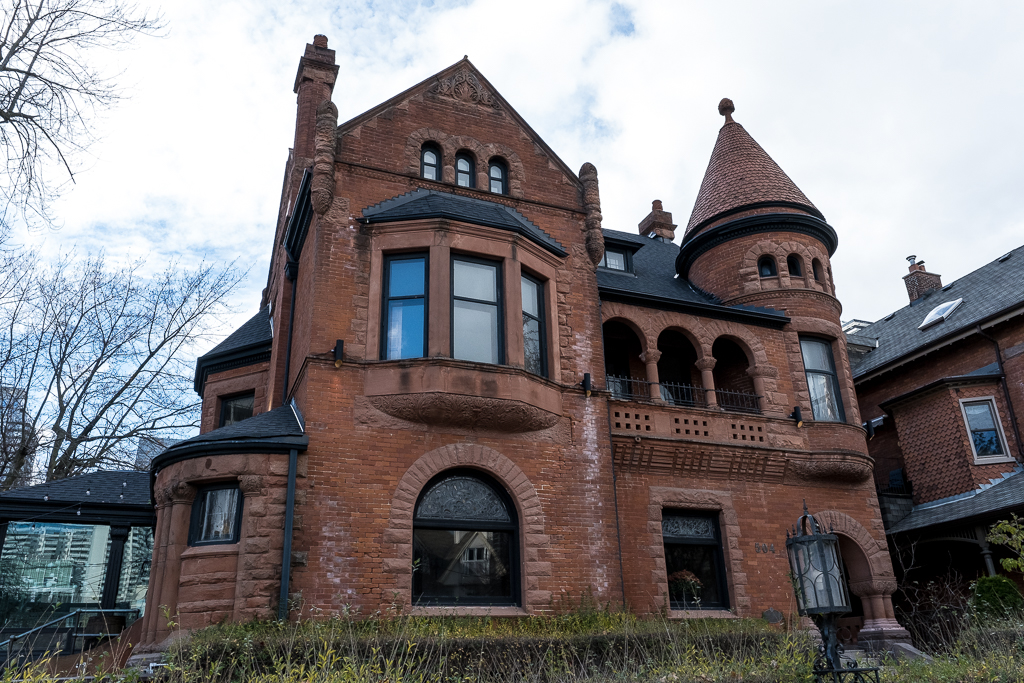
This Richardsonian Romanesque house was built in 1889 for George H. Gooderham.  The Gooderham family owned the Gooderham and Worts distillery which dominated the waterfront, today known as the Distillery District.  At least half a dozen family members owned mansions within a few minutes walk of George Gooderhamโ€™s new mansion.

The conical tower on one side is paired with a bald gable on the other end.  Accents are cut from Credit Valley stone.


506 Jarvis Street

The building is known as the J.H. McKinnon House. Built in 1888 in the Queen Anne Revival style, the house is now a heritage property. It was designed by architects Langley & Burke, who created several other impressive Toronto residences back in the late 1880s.


510 Jarvis Street

Thomas B. Taylor had the house at 510 Jarvis built in 1888.  Taylor had been involved in three paper mills along the Don River including one at Todmorden Mills. The building now consists of luxury apartments (rentals).


512 Jarvis Street
The Gallows House

The Edward Gallow House was built in 1889-90 by E.J. Lennox, the renowned architect who designed Old City Hall and Casa Loma.

When researching this building I was very surprised to learn that the Victorian mansion is now a shelter providing refuge for homeless women. Entitled Mary Sheffield House, it was transformed to a shelter via a joint effort by Fred Victor, a social services organization for homeless and low-income people in Toronto, and the owners of the property, Mike and Giulia Ahmadi. The building is named after Mary Sheffield, who founded a downtown mission to help the poor and destitute, and battled the social problems that plagued Toronto in the late 19th Century.

Prior to its incarnation as the Mary Sheffield House, the building was inhabited by sixteen Jesuit priests for 20 years.


514 Jarvis Street
The Rundle House

The Rundle House was built in 1889-90 also by E.J. Lennox. Built in the Queen Anne Revival style and named after Charles Rundle, one of its owners, The Rundle House has been described by Heritage Canada as one of the most important historical properties in the country. It’s currently used as a residence. The building is the end unit of one of the few intact sections of 19th century Jarvis Street.

The Rundle House was derelict by the 1970s, unheated and deserted. The city took it over in the 1980s. Then it was purchased by Virgin Records and they used it as a sort of haven for musicians who could lodge there and use it as rehearsal space.

While researching this building, I found the following interesting bit on the real estate site loopnet.com:

The three storey, 7,567 square foot building consists of 12 guest rooms, a kitchen/dining area, a living room, a recording studio and a small coach house at the rear of the property. Interior finishes are modernized while retaining historic features. The landscaped corner site of rectangular shape has frontages of 75.2 feet on the west side of Jarvis Street and of 150 feet on the south side of Gloucester Street.


515 Jarvis Street
The Keg Mansion aka Euclid Hall

Designed by architect William Young in the Gothic Revival style, the building was completed in 1868 for businessman William McMaster. In 1882, it was purchased by Hart Massey of the prominent Massey family who built the agricultural equipment firm Massey Ferguson.

In 1915 the home was bequeathed to the University of Toronto’s Victoria College. It was an art gallery in the 1920s, then a restaurant named Julie’s Mansion, with the Bombay Bicycle Club on the top floor.

The mansion, also known as Euclid Hall, was designated as a heritage property in 1973. The building is rumoured to be one of the most haunted in Toronto.


519 Jarvis Street
Chester D. Massey House aka Massey Mansion

519 Jarvis Street is a Toronto heritage building known as the Chester D. Massey House, or alternately, The Massey Mansion. Erected in 1887 by architect E.J. Lennox and renovated most recently in 1907, this official heritage structure stands as the picture of historical elegance along Jarvis Street. The Massey Mansion has an elegant stone arch and entryway, paired with an attractive red brick exterior.

This estate was the childhood home of brothers Raymond and Vincent Massey of the Massey Ferguson farm machinery family. Raymond (1896-1983) grew up to be a movie star, best known for playing Abraham Lincoln on stage and screen. He lived here in this family mansion from 1865 to 1915. Vincent Massey was the first Canadian Minister to the United States, the first Canadian-born Governor General of Canada and the founder of the Canada Council.


571 Jarvis Street
The William R. Johnston House

Now Casey House, this building was designed by the architecture firm Langley, Langley & Burke in 1875 for William R. Johnston, a prominent Toronto clothing merchant. At the time, Jarvis Street was lined with large homes owned by the city’s wealthiest residents. The house remained in the Johnston family until 1941 when it became the national headquarters of the Young Women’s Christian Association (YWCA).

In 2001, the HIV/AIDS hospice Casey House bought the property. Casey House was the first independent HIV/AIDS hospice in Canada – and one of the first in the world – when it opened in 1988 on nearby Huntley Street. It provided compassionate, specialized care at a time when many people with HIV/AIDS faced isolation and discrimination. Casey House‘s services evolved and it became an HIV/AIDS hospital in 2016. in 2017, it moved to the renovated and expanded William R. Johnston House. The addition at the rear was designed by Hariri Pontarini Architects with ERA Architects, greatly expanding the capacity of Casey House.

This building is designated under the Ontario Heritage Act, 2002.


Having worked our way almost to Bloor Street East, our tour of historic Jarvis Street buildings comes to a close. If you’re still reading this rather lengthy post, I thank you for sticking with it to the end!

If you’d like to read more about some of the buildings I’ve mentioned, check out this link to The Mansions of Jarvis Street, which I’ve used as reference for some of the buildings listed in my post.

Elmsley Place Mansions

A private road north of St. Joseph Street, west of Bay Street, is home to red brick Edwardian style mansions that were built in 1892 by Remigius Elmsley as the first subdivisions in the City, located on the former family home, Cloverhill Estate.

The heritage properties are owned by University of Toronto, St. Michaelโ€™s College, some serving as student residences. The four houses of residence collectively contain 20 single and 12 double rooms. The buildings underwent a $4 million renovation in 2007.

The remaining houses are used as administrative offices: Founders House (1 Elmsley); Phelan House (3 Elmsley); and Windle House (5 Elmsley).

Developed during the 1890s, Elmsley Place attracted professionals and politicians, including Sir George W. Ross, who lived at No. 1 Elmsley while serving as Ontarioโ€™s premier. After the Supreme Court of Canada presided over the extension of present-day Bay Street northward during the 1920s, the college purchased the title to the street. By the late 1940s, the laneway was closed off and the Edwardian-style homes were converted to offices and student residences. Today, cut off from traffic, this tree-lined cobblestone lane is a perfect walk into the heart of the St. Mikeโ€™s campus.

The Gates of Elmsley Place
A gateway across from the John M. Kelly Library on St. Joseph Street marks the entrance to Elmsley Place, a laneway that was once a prestigious late-Victorian subdivision. The Elmsley family were major 19th-century landowners whose holdings included what became the original campus of St. Michaelโ€™s College and the current Bay Cloverhill neighbourhood.
Founders House, 1 Elmsley Place
Formerly known as the Sir George Ross House. Sir George Ross was, at various times, a professor, member of parliament, senator, provincial Minister of Education, premier of Ontario, and president of the Canadian Authorsโ€™ Society.
McCorkell House, 2 Elmsley Place
McCorkell House operates as furnished female student dormitories
McCorkell House, 2 Elmsley Place
McCorkell House operates as furnished female student dormitories
Phelan House, 3 Elmsley Place
Phelan House was originally called the William E. Chalcraft House
Windle House, 5 Elmsley Place
Previously known as the H. Hartley Dewart House. The late H. H. Dewart was a former provincial Liberal leader.
Brennan Hall, South Entrance
The Hall is situated on the north end of Elmsley Place, 81A St. Mary Street
Maritain House, 6 Elmsley Place
This house contains furnished male student dormitories
Gilson House, 8 Elmsley Place
This is the only home on the street which St. Michael’s College does not own.

Leslieville’s Crazy Doll House

This one has been on my shot list for quite some time, and I finally got around to photographing it. This visual assault on the senses is known as Leslieville’s Crazy Doll House and has been quite the neighbourhood attraction; it’s one of those things you kind of have to see to believe.

The Doll House is located at 37 Bertmount Avenue, near Queen Street East and Jones Avenue:

The house is owned by one Shirley Sumaiser, who has been collecting stuffed and plastic critters for over twenty years and using them to fill up her front yard.

I stood speechless for some time before I started snapping some shots. It’s almost overwhelming taking in the sheer details of this assault on the visual senses:

The Doll House is not just dollsโ€”there are toys, stuffed animals, plaques, and signs, some hung from the fence, some mounted on wooden stakes, and some lining the porch and eaves.

Apparently owner Shirley Sumaiser’s passion for collecting objects began after her husband passed away. Twenty years later her Doll House is still a beacon in the Leslieville neighborhood.

I’ve read that the collection is often redone or circulated to suit a holiday or a set of new or seasonal additions. The result is an ever-changing garden of tchotchkes that attracts tourists and gawkers (like me) alike.

One last shot before leaving…

“Dreaming”

Installed in 2020, Dreaming is a fairly new creation residing at the Richmond-Adelaide Centre, 100 Adelaide Street West. Spanish artist Jaume Plensa is known for creating large-scale public art installations in major cities, including New York, London, Singapore, Tokyo, and now Toronto.

Dreaming is 3 storeys high and was commissioned by the Oxford Properties Group Inc. in 2016. The artwork alters the areaโ€™s streetscape and anchors a reimagined public plaza called The Terrace at Oxfordโ€™s Richmond-Adelaide Centre. The piece is a cast stone portrait created with white marble and resin, installed on top of a base that serves as a public bench to encourage the public to enjoy the outdoor public space.

This portrait of a young girl with her eyes closed in quiet contemplation was created with the intention of passersby looking inward. Plensaโ€™s vision is for the art to act as a metaphor for humanityโ€™s dreams for the future and for a shared human experience; a concept needed now more than ever before.

As you circle the piece, an optical sensation occurs and the effect messes with your mind and visual senses. Seen from the viewer’s left, the work’s proportions and dimension seem as they should be. As you circle around your right side Dreaming seems to suddenly narrow and it becomes evident how flat the work is in actuality. Viewed directly from the back, Dreaming appears as a small sliver of material.

Dreaming, as it appears from the rear

Here is a short video of the artist speaking about his vision and creation of Dreaming, and the efforts to install the work in the Richmond-Adelaide Centre:

Click here if you’d like to visit the artist’s web page.

The Cottages of St. Nicholas Street

On the charming little downtown street known as St. Nicholas Street, house numbers 45 to 63 are known as “The Cottages”.

In 1883, The Scottish Ontario and Manitoba Land Company built ten row houses on the east side of St. Nicholas Street and named each cottage after a tree: Beach, Birch, Spruce, Hazel, Rose, Maple, Ash, Ivy, Elm and Oak.ย  The properties were occupied by tenants, with occupations ranging from Saloon Keeper to Minister.ย The style of construction was Bay-N-Gable on a 18′ 10″ wide lot. These buildings have been designated under Part V of the Ontario Heritage Act.ย ย A little alley called Cottage Lane provides access to the rear of the houses.

45 St. Nicholas Street
Beech Cottage and Birch Cottage
49-51 St. Nicholas Street
Spruce Cottage and Hazel Cottage
53-55 St. Nicholas Street
Rose Cottage and Maple Cottage
57-59 St. Nicholas Street
Ash Cottage and Ivy Cottage
61-63 St. Nicholas Street
Elm Cottage and Oak Cottage

A rare example of a surviving Victorian terraced row, 45-63 St. Nicholas Street is unique to say the least. The street sits just several hundred metres from Yonge and Bloor Streets, yet feels like a quaint neighbourhood block. St. Nicholas Street was, in fact, originally an alley lane before the row was constructed in 1884.

Leader Lane

Leader Lane is a short street in downtown Toronto. The street was part of the former city of York, Upper Canada, and runs from Wellington Street East to King Street East, crossing Colborne Street. The street was named Leader Lane after the Toronto Leader, a newspaper whose offices were located there from 1852 to 1878.

King Street East and Leader Lane, circa 1920

Leader Lane was the site of York’s first jail and hanging yard. The original jail, a log building constructed in 1796 at the corner of Colborne Street, has long since been demolished. Several buildings, many over 100 years old, remain on Leader Lane.

Walking north from Wellington Street East…

Some of the buildings have different street addresses but face Leader Lane on one of their sides:

The East Thirty-Six Restaurant, 36 Wellington Street East

P.J. O’Brien Irish Pub & Restaurant, 39 Colborne Street

Tom Jones Steakhouse, 17 Leader Lane

The legendary Tom Jones Steak House is one of Torontoโ€™s oldest and most famous award-winning Steakhouses. The structure is a rare surviving late-19th century three-storey commercial building. It housed the first Grand and Toy store, and for the past 50 years has been the location of the Steak House. The building was constructed in 1830 when the street was called Berezy Street.

This building always catches my eye when I pass through the area because its placement is so awkward and unusual – a lonely, standalone structure surrounded by high-rises and the King Edward Hotel.

Somewhere on Leader Lane

Uno Prii’s Annex Apartments

Uno Prii (February 28, 1924 โ€“ November 27, 2000) was an Estonian-born Canadian architect. He designed approximately 250 buildings, many in Toronto, but also around southern Ontario and the United States. Some of Prii’s best-known works are apartment buildings in the Annex neighbourhood of Toronto, featuring outlines which make sweeping curves; these are the buildings I’ll focus on in this post.


11 Walmer Road

Curved balconies are a recurring theme on Uno Prii’s buildings. They act as a kind of false front for the standard flat-walled interiors. Prior to its 2018 renovation, 11 Walmer Road was white concrete, a trademark style of Uno Prii. The building was a collaboration with Polish-born carpenter Harry Hiller, who also collaborated with Prii on 44 Walmer Road.


22 Walmer Road (Walmer Flats)

22 Walmer Road, known as Walmer Flats, is an Uno Prii design that is more unusual than his others, in that it is a low-rise eight-storey building. Today, the balcony panels are made of blue glass, but they originally had a more playful design with large circular cut-outs.

The exact date of the Walmer Flatโ€™s construction is unknown, likely dated to late 1956 or 1957. Based on its boxy design and the lack of whimsy seen in most other Prii buildings in Toronto, Walmer Flats is representative of one of Uno Priiโ€™s earlier projects, when the influence of Bauhaus style in his work was stronger.


In the Swinging โ€™60s, as Toronto began to emerge from its staid conservatism, architect Uno Priiโ€™s Miami Beach-inspired apartment buildings became instant landmarks for their sculptural, flamboyant exuberance. Initially dismissed by the architectural establishment as garish and trashy, Priiโ€™s work began to be rediscovered in the mid-1990s as part of the renewed interest in Modernist architecture and design.
spacingTORONTO

35 Walmer Road

35 Walmer Road, known as The Vincennes, was built in 1966 and signified a new type of apartment building in the Annex. Uno Priiโ€™s designs were a new take on apartment buildings and added a fresh style to the neighbourhood. In contrast to the big and box-like buildings that came before it, The Vincennes was flowing, sculptural, and made of poured concrete.

Rising 15 stories, the building represented the aspirations of city living. Zoning laws in the city required tall buildings to be set well back on landscaped lots, inspiring Prii to create The Vincennesโ€™ large sculptural flare we see today. The futurist sense of Priiโ€™s designs have been described as a symbol of hope and optimism for the future.

A little backstory on The Vincennes:

The home of Timothy Eaton, founder of T. Eaton Co. Ltd., once stood on the same spot as The Vincennes. The Eatons moved into the mansion in 1889, indicating the Annexโ€™s position as โ€œa good address.โ€ After Timothy’s death in 1907, his son and successor, Sir John Eaton, moved out of the Annex, signalling the shift of Torontoโ€™s wealthy family to the surrounding suburbs. Many Annex mansions became boarding houses, student homes, or business offices. Timothyโ€™s daughter, Josephine, gifted the original Eaton house to the Imperial Order Daughters of the Empire in 1934, which served as their headquarters until 1965, when it was sold. Like many of the original mansions, it was demolished to make room for the apartment buildings of the 1960s and 70s.


44 Walmer Road

44 Walmer Road is an excellent example of architect Uno Prii’s unique style. Apartments like this one became commonplace in Prii’s repertoire of buildings.

Affectionately called the Flower Tower, 44 Walmer Road has become one of Priiโ€™s most iconic works. When it was first built in 1969, the balconies had circular, cut-out designs along the railing. This inspired the nickname Flower Tower by Toronto Life because it served as a reminder of the 1960s playfulness of โ€œflower power,โ€ going against then-current ways of building.

Besides the balconies, the circular theme is also found in the canopy structure over the door, where circle cut-outs emit light. It is again repeated with the arches and fountain in front of the building. Uno Priiโ€™s love of circles, loops, and curves gave the building a sculptural sense of fun, making the building stand out against its rectangular neighbours. Uno Prii and his wife Silvia planned to live in the Flower Tower after Unoโ€™s retirement, but the building was so popular and the waitlist so long that the Priis were never able to live there.

In 2001, the Flower Tower was sold to new owners, who renovated the building and removed the iconic circular cut-outs from the railings. One critic stated the change of this โ€œhigh-sculptural, landmark towerโ€ would drive the city further into โ€œarchitectural mediocrity.โ€

Despite protests from tenants and Uno Priiโ€™s family, the Flower Towerโ€™s circular elements were lost. Tenants, architects, and historians called into question the renovation – if architecture is art, does a new owner have the right to change an architectโ€™s original design?


I could see apartment buildings as giant sculptures. I thought people would remember these buildingsโ€ฆI got tired, eventually, of these straight boxes. I thought, let’s have a little fun.
Uno Prii

100 Spadina Road

Completed in 1969, Uno Priiโ€™s 100 Spadina Road Apartments is known for its sweeping curves, decorative surfaces, and articulated balconies. The facadeโ€™s enormous, parabola-shaped swoops make it instantly recognizable among its neighbours.

In 2002, the building was purchased by new owners. Since then, its has become an excellent example of the care given to preserving heritage sites. The building was given full heritage protection in 2007, a move which saved many of its distinctive elements.

When it was built, the buildingโ€™s balcony guards were made using mass-produced decorative concrete blocks. These were difficult to maintain and deteriorated over time. At first, the new owners, Park Property Management, in consultation with ERA Architects, Brook Restoration and Ontech Building Consultants, planned to etch the design of the original blocks onto glass fronts. In the end, the designers chose to install a new “fritted” glass guard, which replicated the original design of the decorative blocks.

“Fritted” glass on balcony fronts

To create fritted glass, a special kind of ceramic material called frit is bound to the glass, creating textures and patterns. This method also reduces glare, cuts building cooling costs, and minimizes potential danger to birds. Although the original concrete blocks were not preserved, the new glass design maintained a portion of Uno Priiโ€™s original vision.


485 Huron Street

Brazil Tower at 485 Huron Street is one of a series of 13 buildings listed on the City of Torontoโ€™s Heritage Property Inventory since 2004. As we see again here, Uno Prii was a designer of apartment buildings with rounded curves and youthful, whimsical forms. It is said that his structures recall the optimism of the 1960s; this one, built in 1966, reflects that. The curved balconies, characteristic of many of his designs, add a touch of Miami Beach flair that give the building a rounded profile.

Cromwell, the building management company who maintains this building, has restored this magnificent tower to its original and much-loved appearance. The interior has been revisited to provide the comfort and todayโ€™s high-end features. The lobby, hallways, and elevators have been refurbished. The garage, freshly redone, also offers a large designated space for bicycles.

Curvilinear balconies are a recurring feature of Prii towers, but in most cases the undulating shapes act as sort of a false front for standard flat-walled suites. At 485 Huron Street, however, behind the rounded balconies are actual semicircular walls. Like bay windows, these costly but effective elements increase natural light and views.


20 Prince Arthur Avenue

Uno Prii claimed 20 Prince Arthur Avenue, built in 1965, was his favourite building, and itโ€™s easy to understand why: the tower captures space age excitement with a rocket-like profile that flares outward at the base, then soars 22 storeys to scalloped peaks.

Blue-coloured balconies blend into the sky, emphasizing the curving white concrete shear walls. 20 Prince Arthur is probably Priiโ€™s most luxurious and best-maintained building, set in expansive, lushly-landscaped grounds with a freestanding fountain. Unfortunately, my shots taken during a mid-February visit do not show off the grounds to their full potential.

Sweeping smoothly upwards the sheared walls form an exaggeratedly flared base to a rooftop crown 22-storeys above the ground. The building looks futuristic, recreating the lines of a rocket ship or bell-bottom pants, depending on your perspective. But Prii claimed centuriesโ€™-old inspiration for the towerโ€™s distinctive feature when he commented:

With Twenty Prince Arthur I finally decided on a contrast of the old and the new. I took the flying buttresses from the medieval cathedrals and I applied them to a modern building.

The rest of the design is restrained: just windows and smooth white surfaces in between the eight evenly spaced buttresses on the buildingโ€™s south and north faces.


Legacy

Uno Prii died on November 27, 2000, leaving behind a repertoire of architecture in Toronto. Like many great artists, he wasnโ€™t often recognized during his own lifetime. He is credited with changing the face of both the Annex and Toronto, reshaping the skyline with space-age, rocket-like designs, pointing skyward towards a hopeful future.

In 2004, 13 of his buildings, mostly located in the Annex, were listed on the Inventory of Heritage Properties. The interest in Priiโ€™s buildings also stems from young architects. Although many architects of the 1990s didnโ€™t take his work seriously, architects of the 2000s see them with fresh eyes and fewer prejudices. Uno Priiโ€™s work shows us that creativity comes from how the tools and materials at hand can be used in new and fantastic ways.

This has been such an interesting post to research and create, and I’ve learned so much about one of Toronto’s most prodigious architects. Uno Prii has created so many more structures in our city, and I look forward to researching those and creating further posts on this exceptionally talented man and his creations.


References

Heritage Toronto: Capturing Mid-Century Toronto

Cromwell

spacingTORONTO

TORONTOist

10 Scrivener Square

What do you do with an abandoned old train station? Why, turn it into a high-end LCBO of course!

Located just off Yonge Street near Summerhill Avenue, this structure used to be the North Toronto Railway Station. It was in service from 1916 to 1930, and closed in 1931 after Union Station opened downtown.

In 1916, architects Frank Darling and John Pearson were assigned the task of creating a new North Toronto rail station. The centrepiece of their plan was a 140-foot clock tower inspired by the Campanile in St. Markโ€™s Square in Venice. Built by the P. Lyall & Sons Construction Company, the station went on to service the Canadian Pacific Railway (CPR) line running across Toronto.

Globe, September 10, 1915

This station was the first building in the city to be constructed of Tyndall limestone from Manitoba, supplied by The Wallace Sandstone Quarries.

When then-Mayor Tommy Church laid the cornerstone on September 9, 1915, he praised the CPR for being the first railway company to give Toronto proper recognition. He hoped the station would be the first of a series of railway gateways to the city, improving inter-city commuting. When passenger service began on June 4, 1916, destinations included Lindsay, Owen Sound, and Ottawa. The most popular route was Montreal, which attracted wealthy businessmen who lived nearby.

Globe, June 15, 1916

When Union Station opened in 1927 and the Great Depression followed shortly thereafter, the North Toronto Railway Station, which served smaller towns in Ontario and was originally meant to augment the bigger station, began to suffer. The last paying passengers filed through the station on September 27, 1930. Brewers’ Retail moved into the northern portion of the terminal building in 1931.

Ticket area, circa 1916
City of Toronto Archives

The station was re-opened, briefly, at 10:30AM on May 22, 1939, when King George VI and his consort, Queen Elizabeth (mother of Queen Elizabeth II), arrived for their first visit to Toronto. This was the first visit to Canada by a reigning British monarch. The King was also officially the Canadian monarch, marking the first visit by one to the city. The royal couple departed Toronto through Union Station. Shortly after World War II, returning soldiers passed through the North Toronto station; they were its last rail passengers.

The building has been protected under Part IV of the Ontario Heritage Act since October 13, 1976.

Inside The Building…

You want booze? There’s nothing you can’t find here – champagne, wine, beer, vodka, gin, whisky, scotch, tequila – you name it, they have that and a lot more. They also carry extensive vintage and imported liquor.

Staying true to the building’s roots, aisles and signs echo its past life

The station has a much, much longer history than I’ve noted, so if you’re interested in reading a more in-depth article, click here for the wiki.

Simcoe WaveDeck

The Simcoe WaveDeck is one of four WaveDecks along Toronto’s Harbourfront. Located at the foot of Simcoe Street – 234 Queen’s Quay West to be exact – it opened in June 2009.

Located at the waterโ€™s edge, the wooden Simcoe WaveDeck features an informal public amphitheatre-style space with curves that soar as high as 2.6 metres above the lake. Inspired by the Canadian cottage experience and the shorelines of Ontarioโ€™s great lakes, the WaveDeck is meant to give urban dwellers a feel for life at the lake.

The other WaveDecks along the Harbourfront are the Spadina WaveDeck (foot of Spadina Avenue), the Rees WaveDeck (west of Rees Street on the south side of Queens Quay), and the Parliament WaveDeck (foot of Parliament Street; currently under development).

The WaveDecks were designed by the firm West 8 Urban Design & Landscape Architecture in Philadelphia, Pennsylvania. The WaveDecks have achieved the Award of Excellence, Ontario Builders Awards (2009) and were nominated for the Conde Nast Traveller Innovation and Design Awards (2010).

The Spadina WaveDeck has been the recipient of numerous prestigious awards including a Toronto Urban Design Award. It was also the first Canadian project ever to be short-listed for the world-acclaimed Brit Insurance Design Awards.

The Rees WaveDeck has been honoured with several awards including a Bronze Medal for Landscape Design from the Design Exchange.

The Simcoe WaveDeck’s Construction

To see a time lapse video of the Simcoe WaveDeck’s construction, check this out:

Future Plans

There is to eventually be a total of 8 WaveDecks along the Harbourfront, and they promise to totally transform our waterfront.

Here’s an interesting video from our controversial architecture critic Christopher Hume, discussing this project and its expansion:

St. Paul’s Basilica

St. Paul’s Basilica is the oldest Roman Catholic congregation in Toronto. It is located at 83 Power Street in the Corktown neighbourhood, near the intersection of Queen and Parliament Streets. Created by architect Joseph Connolly in the Romanesque Revival style, it opened in 1889.

For the following text I’ve borrowed heavily from the History section of the Church’s website:

Established in 1822, St. Paulโ€™s is the mother church of the Archdiocese of Toronto. The first St. Paulโ€™s, of red brick and Gothic style, was completed in 1824. After the diocese was created in 1841, Bishop Michael Power used St. Paulโ€™s as his cathedral until the completion of the construction of St. Michaelโ€™s Cathedral in 1848. In 1847, a typhus epidemic raged through the city, killing 850 people, including Bishop Power. Many were buried on the grounds of St. Paulโ€™s Church and School, though the majority were moved to St. Michaelโ€™s Cemetery at Yonge and St. Clair Avenue West.

In 1880, Bishop Thomas Timothy Oโ€™Mahony was appointed Pastor. He had served in his native Ireland and Australia and was a man of great vision and energy. The old St. Paulโ€™s had to be replaced in order to accommodate the rapidly growing Catholic population of Toronto. Bishop Oโ€™Mahony soon began planning a new church with architect Joseph Connolly. They designed a large structure in Italian Romanesque style, which was rather extraordinary in a city of Gothic churches. The cornerstone was blessed in 1887 by Elzear-Alexandre Cardinal Taschereau, Archbishop of Quebec. The first Mass was celebrated just before Christmas of 1889. The statue of St. Paul was placed above the centre door in 1899.

To the memory of the Irish immigrants who were buried in the adjacent ground during the year of 1847, and in honour of the Right Reverend Michael Power, First Bishop of the Diocese of Toronto, who laid down his life for the fever stricken members of his flock, this monument is devoutly dedicated.
Untitled sculpture in churchyard

Dean John Lawrence Hand was appointed Pastor of St. Paulโ€™s in 1892 and served to 1936. If Connolly designed St. Paulโ€™s and Bishop Oโ€™Mahony built it, Dean Hand completed the church and made it the work of beauty one sees today. He was responsible for commissioning most of the artwork inside St. Paulโ€™s. The four major paintings in the sanctuary and the side apses were finished in 1893. The all-wood organ was installed in 1898 by R.S. Williams & Son, Toronto, and is the only one of its kind in North America. The stained glass windows were installed a year later, and the Stations of the Cross in 1901. The campanile (bell tower) with the bell from the original church was erected in 1905.

Scenes for the life of St. Paul were painted on canvas in 1911. The angels behind the altar were created with the same technique in the 1920s. The bronze Pieta on the front lawn was erected in 1933 as a memorial to Bishop Michael Power and hundreds of parishioners who died during the typhus epidemic of 1847. A plaque at the front entrance bears the names of 81 members of the congregation who died during World War I. Beside the front steps is the grave of Bishop Thomas Timothy Oโ€™Mahony.

In 1998, Father Tom Day began the process of restoring the church to its original splendour. This continued under Monsignor Brad Massman in collaboration with the architect Charles Hazell.

On August 3, 1999, Pope John Paul II elevated St. Paulโ€™s to the rank of Minor Basilica by an Apostolic Decree. To be given this Papal honour, a church must be a centre of liturgical and pastoral life in the diocese and renowned for its antiquity, beauty, canonical significance or devotional popularity. Minor Basilicas receive special concessions such as the privilege of granting plenary indulgence on certain days in a year. The insignia of a Minor Basilica include the Ombrellino or Pavilion (a red and yellow umbrella) and the Tintinnabulum (a processional bell). St. Paulโ€™s is the twentieth church in Canada to receive this honorific title.

« Older posts Newer posts »

© 2026 TO Cityscapes

Theme by Anders NorenUp ↑

Subscribe to TO Cityscapes

Subscribe to TO Cityscapes

Join my mailing list to receive an email alert when I publish a new post.

You have successfully subscribed! Check your email for further info.