
A little black and white photo exercise today, focusing on the curves and angles of a few downtown structures.


Toronto Through My Lens
A little black and white photo exercise today, focusing on the curves and angles of a few downtown structures.
I’ve known about the so-called “Cube House” for several years and have always wanted to get some shots of it. I finally paid a visit to the building this past weekend.
The Cube House is located at 1 Sumach Street beside the busy Adelaide Street East and Richmond Street East overpasses, which is kind of an odd location. Sumach Street is strangely laid out near the Cube House – it ends in a stubby dead end with a second Sumach Street running parallel to the first, then the two streets pick up as one on the north side of the Richmond Street East overpass:


I remember the Cube House being very popular years ago during the Doors Open Toronto events. Sadly, this unique piece of Toronto architecture is now abandoned and derelict. This being Toronto, where we don’t preserve our past or any interesting structures, there is a move to demolish the building to construct – wait for it – more condos.

The Cube House was built in 1996 by Canadian architect Ben Kutner and his partner Jeff Brown. When the architects designed their cube home, they modelled it after Dutch architect Piet Blom’s cube houses in Rotterdam which were built in the 1970s:
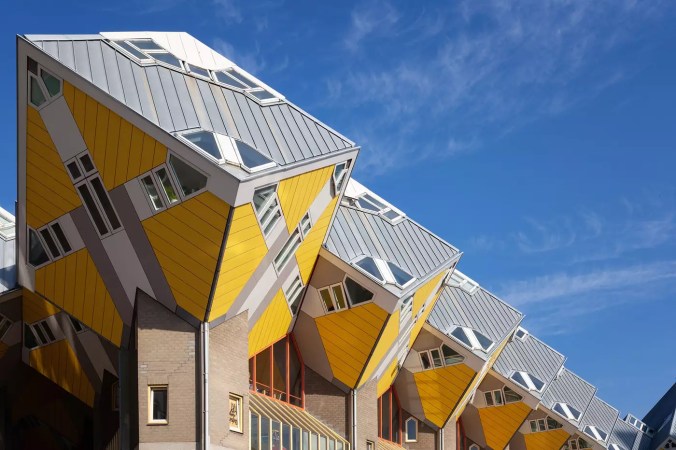
The Canadian architects intended to use the home as a solution for affordable housing on unusable parcels of land and originally planned to construct more. The architects envisioned that the Cube House would be moved around to different locations across its lifespan rather than permanently staying in its current location.


In May 2016, the property was purchased by commercial real estate expert Taso Boussoulas and real estate developer Jeff Craig for $2,750,000.
I’m glad I got these shots when I did; the Cube House’s future is very uncertain. We’ll just have to wait and see what happens to it down the road.
A little photowalk capturing Harbourfront, York Street and Union Station in glorious Black & White.


This installation in Maple Leaf Square is entitled Search Light, Star Light, Spot Light, created by John McEwan and unveiled in 1999. The 3-column steel sculpture is inspired by a quote from author Louis Untermeyer: God, if you wish for our love, Fling us a handful of stars.


The surface of each column has been extensively perforated with holes in the shape of five-pointed stars that glow when lit from within like celestial search beacons in the night. The effect is most immediately associated with the search beams that call attention to entertainment spectacles such as those that take place in the adjacent Scotiabank Arena.

Art critics of the sculpture say that the telescopic shape of the columns and the starry lights suggest a connection between the earth and sky; between the infinite cosmos and the depth of the human imagination.

Entering via Bremner Boulevard:


The Arts and Letters Club of Toronto is a private club which brings together writers, architects, musicians, painters, graphic artists, actors, and others working in or with a love of the arts. Located at 14 Elm Street, the Club is located in an historic building called St. George’s Hall.
St. George’s Hall is designated as a National Historic Site. The mandate of the Arts and Letters Club of Toronto is to: advance the arts and letters, by and through its members who practice and contribute to the arts, in the conviction that the arts are essential to a healthy, enlightened society.

The building was built by the St. George’s Society in 1891. The Arts and Letters Club leased it in 1920 and purchased it in 1986. The 3-storey building has been extensively renovated and is wheelchair-accessible.
The Arts & Letters Club of Toronto has been designated a building of National Historic Significance by the Government of Canada.
The Great Hall is home to a cathedral ceiling, large fireplace, a choir gallery, a well-equipped stage and a Steinway grand piano, no less. The numerous wall banners celebrate the names of illustrious early Club members.


The Great Hall holds rotating exhibitions of paintings, drawings and photography; the Hall also serves as an intimate concert hall and theatre. Its principal function, however, is as a dining room, where members and their guests dine and socialize around refectory tables.


The entrance displays some of the Club’s Presidential portraits. They continue around the ceiling of the lounge . Each Club President selects a Club artist to create a portrait at the end of the President’s term.

I crossed Harbord Street a few months ago to reach Spadina Avenue. Harbord Village is a established, gentrified area but there was a little section of Harbord Street between Spadina Avenue and Huron Street that was distinctly abandoned, with the old houses crumbling. Here are some of the sad, derelict houses I encountered:


For today’s post, let’s take a little trip to the east end of the city.
The R.C. Harris Water Treatment Plant is an absolute masterpiece of Art Deco, located on the shore of Lake Ontario at 2701 Queen Street East in Toronto. The plant was designed in 1929 and built from 1932 to 1937. It opened in 1941 and was later expanded from 1955 to 1958. The plant is named after Roland Caldwell Harris, who was the Commissioner of Works from 1912 until his death in 1945.

The structure looks like a museum, but is actually a water treatment plant. Surprisingly, the inside of the building is similarly elegant, with cavernous halls and marble passages, all full of filtration equipment. This opulence has earned the building the nickname “Palace of Purification.”
There are three buildings comprising the plant: the Filter Building, the Service Building and the Pumping Station. Together they represent the largest example of Art Deco in the entire city. The use of marble, bronze and carved limestone is prevalent throughout and typical of the Art Deco architectural style.


The water treatment plant is the largest one in Toronto. It produces 30% of Toronto’s drinking water and can potentially produce 950 million litres daily.
The R. C. Harris Water Treatment Plant has been used in dozens of films and television series as a prison, clinic or headquarters.


A beautiful place to enjoy.
It was a crisp fall day when I started my Avenue Road photowalk at Bloor Street West. I made my way up Avenue Road, reached Dupont Street, then returned south until I hit University Avenue and Dundas Street West. Here’s a little of what I encountered along the way.


Lots of angles and contrast between the Michael Lee-Chin Crystal at the ROM and the Exhibit Residences across the street at 200 Bloor Street West.


The Church of the Redeemer, at 162 Bloor Street West, sits at the very busy intersection of Bloor Street West and Avenue Road. This Anglican Church was founded in 1871 and opened its doors at this site on June 15, 1879. At that time the area was still on the fringe of the city (hard to imagine now…). The Church’s architectural style is Gothic Revival.
The Church of the Redeemer is known for its progressive stance on social issues, especially gay rights. In 1998, the congregation published An Honourable Estate: Same Sex Unions and the Church, advocating the blessing of same-sex unions. The parish uses exclusively the Book of Alternative Services.
From time to time the church also hosts a range of musical events and concerts. I remember seeing singer-songwriter Gary Jules here several years ago and thinking what a cool venue it was for a concert.


“The walls were covered with rubble stone from the Credit Valley, near Georgetown. The term rubble stone means that the stones were the rubble that remained after stones were cut in the quarry. They were irregular in shape and their sizes varied. However, though rough in texture and inexpensive, they created a pleasing effect when assembled on the church walls. Ohio sandstone was imported for the stone ornamentation and the trim around the windows of the church. The interior walls were of white and red bricks, enhanced by including geometric patterns. The support columns in the interior were constructed of polished granite from the Bay of Fundy area.”1


The Church underwent major renovations in the 1980s. At that time the parish hall on the north side of the Church was sold; because of this the Church lacked sufficient space for offices and meetings. The problem was solved by raising a section of the floor of the Church to expand the basement level. Pews were removed from the raised section at the rear of the nave and replaced with chairs, as you see here:


1Doug Taylor’s website: Historic Toronto: Information on Toronto’s History
Sculptor Shayne Dark, a Kingston native, has three sculptures which dot Toronto’s downtown condo landscape.
Double Vision is located on the northwest corner of Jarvis and Charles streets in front of X Condominium at 558 Jarvis Street. The huge red poles jutting out of the sidewalk bring to mind bamboo shoots.


Just across the street, at 101 Charles Street East in front of The X’s younger sister building X2, sits Double Take. It is characterized by the same monumental poles, but this time they are slightly slanted toward Double Vision as if the two pieces are communicating. You have to be careful when you come out of Rabba at this site, as you could potentially brain yourself or take one of these in the eye… not the best way to appreciate the artwork.


It’s an interesting project because there’s a dialogue between the two pieces across the road from one another. You’ve got the red vertical sticks, then you’ve got the blue horizontal ones and it sets up a dynamic and creates a threshold. They are engaging both in their own right and also with one another. They engage in an interesting artistic and architectural discussion,
Brad Golden, a Toronto public art consultant whose job it is to partner with developers and organizations to help them figure out what kind of art would work for their space.
Shayne Dark’s third condo-based sculpture, Nova, is located at the Tableau Condominium at 125 Peter Street. The piece is completely incorporated into the structure of the building.

Initially, we’d walk in the forest or along the lakeshore and I’d find these interesting found objects, like a big pile of sticks and pieces of driftwood, and these became my art practice. I think for any artist, where you live is so important. Being Canadian at this point in history, on this day, in this time is an experience and feeling I want to document. I feel where you’re from can not help but influence every artist’s practice to some degree.
“Under Section 37 of Ontario’s Planning Act, developers are allowed to have taller buildings or more units and other such concessions in exchange for putting a minimum of one per cent of the project’s construction costs toward public art. The art can either be on-site, on city property nearby, or a combination of both. The guidelines set out by the program ensure that the art is of public benefit and is also visible, accessible and adds to the urban character of the city in a positive way.
Financial investment is a huge factor for anyone who makes their living as a sculptor. Shayne Dark, the artist, says it costs literally tens of thousands of dollars to manufacture the materials necessary to make those big public art projects you might see as part of a condominium development.
‘Those jobs in Canada are few and far between. But luckily, what ended up happening in a few major Canadian cities was this one percent rule where if you were a developer working on a public building, a portion of the construction costs would actually go to art,’ says Shayne Dark”.1


Yes I've seen these sculptures and have enjoyed them. Sculptures and statues really liven up a city!
You know what Marvin ? I never knew about this. I really have never got close enough to see all…
Yes Marvin. I have been to a couple of these festivals in the past. It is a HUGE EVENT now…

I have always admired this sculpture but it seems to disappear amongst all the grey facades of the surrounding buildings.…
© 2026 TO Cityscapes
Theme by Anders Noren — Up ↑

Join my mailing list to receive an email alert when I publish a new post.


The word hidden is often overused but in this case it feels apt. This large space is quite pretty and…