Toronto Through My Lens

Author: Marvin Job (Page 22 of 34)

The Cube House

I’ve known about the so-called “Cube House” for several years and have always wanted to get some shots of it. I finally paid a visit to the building this past weekend.

The Cube House is located at 1 Sumach Street beside the busy Adelaide Street East and Richmond Street East overpasses, which is kind of an odd location. Sumach Street is strangely laid out near the Cube House – it ends in a stubby dead end with a second Sumach Street running parallel to the first, then the two streets pick up as one on the north side of the Richmond Street East overpass:

I remember the Cube House being very popular years ago during the Doors Open Toronto events. Sadly, this unique piece of Toronto architecture is now abandoned and derelict. This being Toronto, where we don’t preserve our past or any interesting structures, there is a move to demolish the building to construct – wait for it – more condos.

The Cube House was built in 1996 by Canadian architect Ben Kutner and his partner Jeff Brown. When the architects designed their cube home, they modelled it after Dutch architect Piet Blomโ€™s cube houses in Rotterdam which were built in the 1970s:
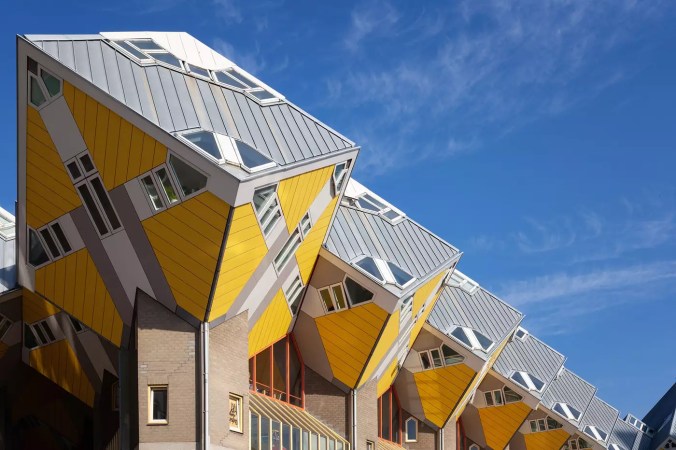
Piet Blomโ€™s cube houses in Rotterdam, Netherlands
This photo courtesy of blogto.com

The Canadian architects intended to use the home as a solution for affordable housing on unusable parcels of land and originally planned to construct more. The architects envisioned that the Cube House would be moved around to different locations across its lifespan rather than permanently staying in its current location.

I found some interesting facts about the Cube House:

  • It took architect Ben Kutner 10 years to get permission from the city to get the plans approved.
  • The ownership of the property became a legal battle for over a year because the cubes were built on land that was not owned by the architect. As a result, the cubes were deemed the property of the landowner.
  • Eventually, in the early 2000s, the land and structure were sold to Coffee Time founder Tom Michalopoulos for $265,000; he utilized the cubes as billboards for his coffee business.

In May 2016, the property was purchased by commercial real estate expert Taso Boussoulas and real estate developer Jeff Craig for $2,750,000.

I’m glad I got these shots when I did; the Cube House’s future is very uncertain. We’ll just have to wait and see what happens to it down the road.

From The Vaults: “The Nindinawemaaganidok / All My Relations” Mural Project

It’s time for another installment of what I’ve dubbed From The Vaults, which are TOcityscapes from several years past. These shots are from January 12, 2013 so I think they qualify as Vaults material.

For about 4 years in the early 2010s, there was a huge wooden hoarding/fence on the south side of Allan Gardens. The hoarding surrounded the main construction site of the Gerrard Watermain Replacement Project. Allegedly the size of 2 football fields (719 feet), the hoarding served as a massive art canvas for Toronto Aboriginal community artists.

Entitled The Nindinawemaaganidok/All My Relations Mural Project, the artwork was a visual representation of First Nations life and culture in Toronto. Led by nationally recognized and award winning artists Tannis Nielsen and Philip Cote, 21 artists from the First Nations community came together to design and paint the mural.

The mural depicted 5 different topics combined with Aboriginal history in the city of Toronto:

  • Aboriginal women who have been murdered or have gone missing across Canada
  • A time line of the creation story to present day
  • The North and South Indigenous nations coming together
  • Indigenous teachings
  • The importance of water

Here’s how it looked:

    I couldn’t find any further history as to what happened to the mural after it was dismantled. At one point I heard it was to be auctioned off during the Pan Am games when they were hosted in Toronto a few years; I don’t know if that ever came to pass, though. At any rate, it proved to be an inspiring and beautiful mural for a number of years in Allan Gardens.

    Harbourfront + Union Station in Black & White

    A little photowalk capturing Harbourfront, York Street and Union Station in glorious Black & White.

    Harbourfront


    The View From York Street


    Maple Leaf Square, Outside the Scotiabank Arena
    (formerly the Air Canada Centre)

    This installation in Maple Leaf Square is entitled Search Light, Star Light, Spot Light, created by John McEwan and unveiled in 1999. The 3-column steel sculpture is inspired by a quote from author Louis Untermeyer: God, if you wish for our love, Fling us a handful of stars.

    The surface of each column has been extensively perforated with holes in the shape of five-pointed stars that glow when lit from within like celestial search beacons in the night. The effect is most immediately associated with the search beams that call attention to entertainment spectacles such as those that take place in the adjacent Scotiabank Arena.

    Art critics of the sculpture say that the telescopic shape of the columns and the starry lights suggest a connection between the earth and sky; between the infinite cosmos and the depth of the human imagination.


    Union Station

    Entering via Bremner Boulevard:

    Taken while Union Station was still under renovation

    “Garden Of Future Follies”

    On the Front Street Promenade (Front Street & Bayview Avenue) near the new Canary District/Corktown Common area, there is a curious sculpture set of 7 pieces by artists Hadley+Maxwell.

    The Garden of Future Follies (2016) is a bronze sculpture garden bringing together elements from over 80 existing public sculptures and architectural details from around the City of Toronto. To create the garden, fragments of existing Toronto sculpture were cast using a Cinefoil casting technique โ€“ pressing material directly onto a sculpted surface โ€“ to generate over 150 unique impressions that were subsequently cast in bronze.

    A Little About the Artists

    Hadley+Maxwell (Hadley Howes, Maxwell Stephens) are a Canadian artist duo formed in Vancouver in 1997 and now based in Berlin. Their body of work includes installations, performances and writings that employ a diverse array of media to rework iconic images and traditional forms as they are expressed in pop-cultural, artistic, and political movements.

    A Broadview Walk

    COVID-19 was raging in the middle of 2020 when I took these shots. For this photowalk I did a mini-tour of Broadview Avenue from the Danforth up to Mortimer Avenue, then back again. The street was deserted – I didn’t encounter a soul on this little jaunt; definitely a sign of the times.

    Empty Streetcars
    Broadview TTC Station
    Mural
    894 Broadview Avenue
    Tony’s Barber Shop
    910 Broadview Avenue

    On the side of the Rosicrucian Regional Cultural Centre
    835 Broadview Avenue

    Definitely Retro
    850 Broadview Avenue
    Decrepit Doorway
    Somewhere on Broadview Avenue

    Untitled Murals on Broadview Avenue

    BikeShare Toronto
    On Broadview Avenue

    โ€œBusinessman On A Horseโ€

    This 1989 bronze sculpture by William McElcheran is somewhat tricky to find. It is tucked into a small square in St. Michaelโ€™s College at U of T.

    The artist has remarked that the businessman replaces the classical hero. Instead of dealing with heroic imagery, McElcheran endeavours to find his idea of the “larger-than-life” non-hero. Inspiration for the piece grew as he watched the “fat cats” wheel and deal on the corner of Bay and King Streets.

    There are more works by McElcheran around Toronto, which I endeavour to find for future TOcityscapes posts.

    Bonus!

    Although technically not a TOcityscape, there is another of William McElcheran ‘s sculptures located in Calgary on Stephen Avenue at 1st Street S.W. This one is called Conversation, and was presented to the City of Calgary by Norcen Energy Resources Limited in 1981. Vince and I were in Calgary in the fall of 2019, which is when I grabbed this shot:

    William McElcheran is now internationally recognized for his bronze figures of portly businessmen, portraying these self-important men of trade in different settings and situations. His commissioned works can be found in churches, subways, and numerous public places worldwide. Since his death in 1999, McElcheran forgeries have appeared on the market, which is indicative of how well regarded and widely accepted his works have become.

    “Rune”

    At 7 Hart House Circle in the University of Toronto sits a bronze sculpture entitled Rune. Placed in 2001, the piece was created by artists Randy Gledhill and Berenicci Hershorn.

    What exactly is a “rune”? Merriam-Webster defines rune as: any of the characters of any of several alphabets used by the Germanic peoples from about the 3rd to the 13th centuries. As applied here I would imagine rune refers to information/education as provided by a university.

    The Toronto Chinese Archway

    Opposite Bridgepoint Health Centre (now Hennick Bridgepoint Hospital) , near the intersection of Gerrard Street East and Broadview Avenue, there stands the Zhong Hua Men gate, aka Toronto Chinese Archway. The gate serves as an entrance-way to the Chinese community in this neighbourhood.

    The Archway’s official construction began in late 2008 and opened to the public, with a ceremony by then-Mayor David Miller, on September 12, 2009. The creation of the Archway came about in large part due to the efforts ofย Valerie Mah,ย as a member of the Chinese Chamber of Commerce of East Toronto, together with Councillorย Paula Fletcher.

    The two stone lions, each weighing 3 tons, sitting at the base of the Archway are a gift from the People’s Republic of China. The project cost roughly $900,000.00, of which the City of Toronto contributed $415,000.

    Ten years in the making, the Archway was the brainchild of Dale Cheung, President of the Chinese Chamber of Commerce (East Toronto) and Bernard Loh, the group’s Vice-President, as well as a small group of past and present members. The group dreamed up the project, back in the day, while having Dim Sum with the area’s former City Councillor, Jack Layton.

    In keeping with the traditional Chinese Paifeng style of commemorating the great achievements of ones ancestors, the Zhong Hua Men Archway is engraved with messages of goodwill and wisdom.

    The Archway and parking lot next to it has since won a prestigious international award in 2012 forย Best Design/Implementation of a Surface Parking Lot.

    The lions are lifted into place, 2009
    This photo courtesy of The Toronto Star

    “Ballast”

    In front of the Hudson condo at 438 King Street West, there sits a sculpture by artist Jed Lind, entitled Ballast.

    Installed in 2013, Ballast is a patinated bronze sculpture of the prow of a ship, anchoring the corner of King and Charlotte streets in Toronto. Rising like a skeletal prow of a Great Lakes freighter, the five-metre tall bronze sculpture is described by artist Jed Lind as a visual metaphor for the transformation of the King Street corridor from working class to creative class. The artwork began as a maquette that was laser scanned and enlarged. After hours of meticulous sculpting and finishing of the enlarged positive form, the sculpture was cast in bronze in small sections. The sections were welded together, finished, and the bronze was patinated.

    Jed Lind’s photographs, sculptures, and installations are populated with nautical vessels and vehicles, though they are not always immediately recognizable. On this particular creation, Jed Lind has commented:

    Transformation is central to my work whether physical, emotional, or metallurgical. Ballast represents for me a transformation of the King Street corridor which is so drastically different than my memory of it growing up. Ballast is modelled on the frontend of a working lake boat, or Lakers as they are called. The boat is a nod to the blue collar working class that used to occupy the now vacated commercial and industrial spaces, while the geodesic pattern is a reference to Buckminster Fuller who inspired youth cultureโ€”in the late 1960s and 70sโ€”to transform their existing circumstances through architecture. I hope Ballast will be a model for the younger generation who have taken over downtown en masse.

    « Older posts Newer posts »

    © 2026 TO Cityscapes

    Theme by Anders NorenUp ↑

    Subscribe to TO Cityscapes

    Subscribe to TO Cityscapes

    Join my mailing list to receive an email alert when I publish a new post.

    You have successfully subscribed! Check your email for further info.

    Pin It on Pinterest